kuniga.me > NP-Incompleteness > 2025 in Review
2025 in Review
01 Jan 2026
Posts Summary
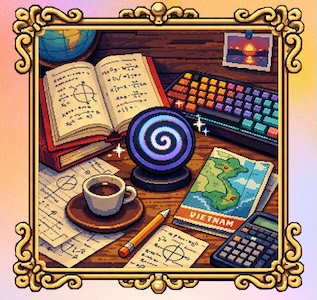
In 2025 I focused mostly in my studies of Complex Analysis, C++ and operating systems. I was happy with the balance of work vs non-work related (almost half-half).
Complex Analysis
I started reading the book Complex Analysis by Ahlfors in September of 2023. I’ve made steady progress on it in 2025 but I’ve changed my goal of covering every single topic on the book. I skipped a few topics from the chapters on the Dirichlet problem.
My current plan is to study the elliptic functions chapter but skip the last chapter on globally analytic functions and my new estimate is that I can finish this book before mid 2026.
Here’s a list of all the posts I wrote as notes from the book this year:
- The Maximum Principle
- The General Form of Cauchy’s Theorem
- The Residue Theorem
- Runge’s Theorem
- Mittag-Leffler’s Theorem
- Weierstrass Factorization Theorem
- The Gamma Function
- Harmonic Functions
- Hadamard Factorization Theorem
- The Riemann Zeta Function
- Subharmonic Functions
- The Perron Method
Work
I learned more about C++ such as Views, Concepts and CPOs. I also studied Folly futures, executors, coroutines and their lifetimes. As a background for Folly executors I also studied asynchronous I/O.
I studied how C++ binaries are compiled (in particular by LLVM), linked (via shared libraries) and executed (ELF and jemalloc). More generally, I also had posts on distributed systems and operating systems: I wrote about queues, read books on microservices, system performance and BPF.
I’m satisfied about being able to read so many technical books this year. I did this by reserving 30-60 min each morning to reading, and got through 4 books amounting to a few thousands of pages. I applied some techniques described in Atomic Habits: I comitted to read at least one page a day and more importantly I started using a new phone without any work related nor social media apps. It’s incredible how much time I had been wasting each morning on those.
Leisure
I didn’t explore much outside of work and complex analysis but I enjoyed writing about my last visit to the Computer History Museum.
I belatedly completed the Advent of Code 2024. It was a fun experience and I started writing a post about the problems but didn’t have time to finish.
Personal
I wrote more “shower-thoughts” / personal opinion posts about neomania, horseshoe theory and complex systems. A bit short of my plan of writing once a quarter but I’ve enjoyed working on these and hope to continue next year.
The Blog in 2025
Numbers
I’ve have a resolution to post at least once a month on average but this year I actually averaged more than one post every other week, by writing 58 of them. The blog completed 15 years with 269 posts.
I still use GoatCounter for analytics. The tool A Bulls and Cows Solver continues to be the most visited page with 4,744 visits. This is a solver I built for fun in 2018 as part of a post, Bulls and Cows, which is a code-breaking 2-player game. I explain why this page in popular in my 2024 review.
Restricted to the blog, Linear Predictive Coding in Python written in 2021 continues to be the most popular post with 654 visits. Surprisingly, a post I wrote in 2024, Understanding std::call_once() in C++ became quite popular with 571 visits. From this year, Folly Executors had the most visits, 119.
Overall traffic to my website grew by a tiny amount, from 17,098 to 17,145.
AI
I’ve been noticing a drop in traffic to my blog posts, which I attribute to tools like ChatGPT and the fact that Google now often answers questions inline without users having to click links.
I actually don’t mind this change in pattern too much. I never wrote with visits in mind, but I’m happy when I see a popular post because I assume people find it useful. With AI it’s still possible that my posts are helping people behind LLMs but I lost any visibility.
Citations
From time to time I Google my blog address to see if I can find any interesting references and this time I found it has been cited by a paper by folks at Purdue: Unbalanced optimal transport for stochastic particle tracking . I couldn’t find it in any journal and it doesn’t seem peer reviewed, but it cites a 2013 post Totally Unimodular Matrix Recognition.
Most of my posts do not provide original ideas, being just notes on books and papers I read, so I’m surprised that anyone would cite it instead of the original source directly, but then most textbooks are also not original (in content, but are in presentation) often sourcing from papers and still, many papers cite textbooks.
Resolutions for 2026
As I mentioned above, I’ll commit to finish learning about complex analysis. I’m hoping to have time to start a new topic, which for now is classical mechanics.
I also want to explore more LLM tools such as Claude. The landscape has been changing very fast and I find hard to be on top of the best tools, so I want to dedicate time to explore them in more depth. I usually don’t follow the newest trends but this might time well-spent because it can make me more efficient and end up saving time in the long run.
Personal
The end of the year is a good time to look back and remember all the things I’ve done besides work and the technical blog.
Trips

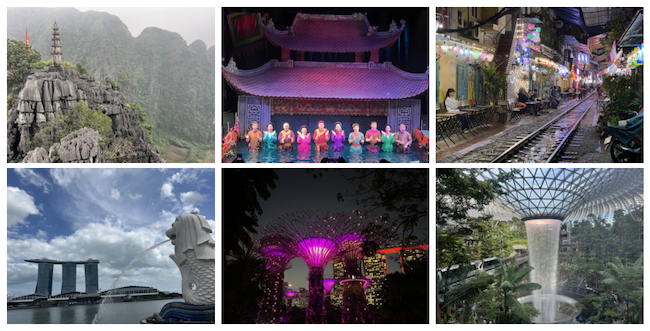
In February, we visited Singapore and Vietnam. It was my first time in Southeast Asia and I learned a lot about the rich Vietnamese history and enjoyed the local food a lot.
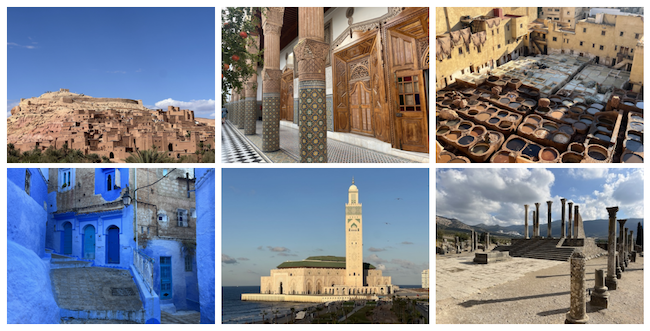
In November after a business trip to London, we decided to visit Morocco. I also learned a lot about Morocco’s history and was fascinated by its Islamic architecture, especially the tile work (zelije). It was a nice historical connection to the trip to Andalucia last year because the Moors from Andalucia came from Morocco.
We also did quick trips to Portland, Oregon and Denver and the Rocky Mountain National Park in Colorado.
Books
This year I started publishing the notes for books I read as soon as I finish them. In fact from now on I don’t consider a book read until I do that. The list of all books I read this year is now on my books page. In this post I’ll make some overall commentary.
Fiction and Poetry
This year I read more fiction than usual, in particular sci-fi. Recommended by a friend, Manna is an interesting thought-experiment as to what can happen if most of human work is automated. I’ve been wanting to read Asimov for a while and finally scratched the itch with I, Robot. It contains lots of interesting ideas between human-robot interactions.
I initially didn’t enjoy reading Borges’ Ficciones because I couldn’t grok the heavily philosophical first story but the subsequent ones were pretty interesting. Also, after reading the entries on Wikipedia I realized there were many other layers I had missed. I especially liked the Tower of Babel.
Other fictions I read were The Tempest and Pachinko. The Tempest was the first text I read from Shakespeare and found it underwhelming. Pachinko was okay.
I read my first book in Spanish, Romancero Gitano, a poetry book with very involved metaphors. It would have been hard to understand this book even in my mother language, but luckily it has lots of comments.
History and Travel
I finished reading The Scramble for Africa which I started in 2024 after visiting a few countries in Southern Africa. It covers a short period of time but geographically it’s very broad: it mentions a large part of countries in Africa.
For trip-related books, this year I read Perfume Dreams and Fire in the Lake for Vietnam and Singapore: A Very Short History for Singapore. While they’re not bad, I didn’t get the historical information I was after, except for the Singapore one. I decided that going forward I’ll just read Wikipedia.
I did just this for Morocco. I read the main Wikipedia page and found it a lot more effective at learning about its history. To complement it, I read the memoir For Bread Alone by the Moroccan Mohamed Choukri in hope of some cultural immersion, without success. I still haven’t found a good way to learn about a country’s culture through books. The closest I got is through travel guides like Lonely planet.
With similar hopes I read the book A Lady’s Life in the Rocky Mountains for a trip to Colorado and Portlandness for Portland. The former wasn’t very insightful, but the latter did provide some interesting cultural background to Portland and I enjoyed the data viz from it.
STEM
I read The Body which covers interesting bits about the human body. I also re-read The Music of the Primes which I had read over a decade ago. I knew it was about the Riemann Hypothesis, and I wanted to revisit it after studying The Riemann Zeta Function .
I also read the biography of von Neumann, The Man from the Future. I like learning about the history of mathematics, so I wanted to see if I’d enjoy reading biographies of mathematicians. It was an interesting but not an amazing read, so not sure I want to make a habit of it.
Psychology
I enjoyed reading some books on self-improvement such as The Almanack by Naval Ravikant, Nonviolent Communication and Atomic Habits (re-read).
