kuniga.me > Books > Nonviolent Communication
Nonviolent Communication
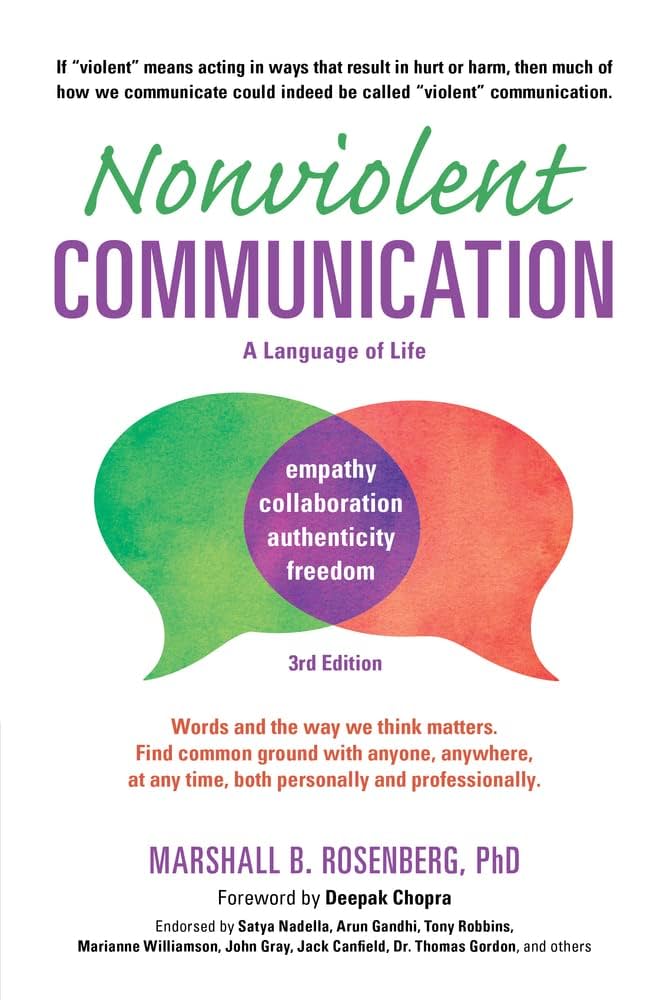
In this book, Marshall Rosenberg provides techniques for communicating more effectively.
In my opinion, the title of the book undersells the content. My first assumption was that this book was meant for dealing with anger in communication, but really is about how to communicate our needs more clearly and be more self-aware.
This book has 14 chapters and about 220 pages. It has lots of examples and the earlier chapters have exercises to test our comprehension.
This page contains some of my notes from the book.
The NVC Process
Nonviolent communication is often abbreviated as NVC. The general process consists of these 4 steps:
- Observations
- Feelings
- Needs
- Requests
The NVC practitioner needs to observe facts, then understand the feelings, then understand the underlying needs and finally communicate (or hear) how those needs can be satisfied.
Observations
A key aspect of making observations is to be objetive and specific. Avoid opinions such as judgement, comparisons, etc. The idea is not to “lose” the other person in the 2-way conversation. The main way this happens is if the other person gets defensive and stops hearing what we have to say.
We make moralistic judgements when someone doesn’t align with our values. For example, we may value hard-work and judge someone whom we perceive behaving in a way not aligned with that value. For the previous example we might say/think: “she’s lazy”.
One way to catch ourselves making judgements is by observing our choice of words. There are several helpful examples provided in the book on how to rephrase an evaluation into an observation.
| Subjective | Objective |
|---|---|
| Doug procrastinates. | Doug only studies for exams the night before. |
| You seldom do what I want. | The last 3 times I initiated an activity, you said you didn’t want to do it. |
Feelings
In English, we can say I feel even when we’re not expressing our feelings. A way to tell if that’s the case is if it can be replaced by I think. In fact, saying I feel is not always needed. Example: I’m feeling irritated. vs I’m irritated.
We’re not expressing our feelings when:
- I feel is followed by words such as if, for example I feel as if I’m living with a wall; or by pronouns or names, for example: I feel I am constantly oncall.
- Describing an opinion we have of ourselves. Example: I feel inadequate as a guitar player (opinion) vs. I feel disappointed in myself as a guitar player (feeling).
- Projecting how others perceive us. Example: I feel ignored (projection) or I feel lonely.
What others do are never the cause of how we feel. We need to dig one level further and understand our needs.
Needs
When expressing our feelings, we may be tempted to attribute it to some external cause:
- I feel angry because the supervisor broke her promise.
But we can go a step further and connect to our needs:
- I feel angry that the supervisor broke her promise, because I was counting on getting that long weekend to visit my brother.
When communicating our needs it’s preferred to use positive language because it’s more specific. An anecdote provided by the book is about a woman who asked her hustand to not spend so much time at work. He complied and signed up for a golf tournament. The real need from the wife was to spend more time together.
Sometimes the other side might misunderstand our needs, so it might be useful to ask them to reflect back to us in their own words.
Requests
Once we communicate our needs we can communicate what actions would satisfy those needs. We must make sure not to confuse requests with demands. The difference boils down to what we do if the other side says “No” to our request.
If they think they’ll be blamed or judged, they might comply but not sincerely and we might miss the opportunity to understand the underlying reason for the “No”.
Conclusion
In general I found the book provided useful tips for communicating better and having more harmonious conflict resolution. I think a big part of that is our wording, being very careful about not triggering the other person, but I feel like sometimes it becomes very convoluted and hard to understand, for example: Are you wanting me to tell you my reasons for saying what I did?
The book doesn’t seem to address the limitations of NVC, but according to it:
The objective of NVC is not to change people and their behavior in order to get our way.
If however an outcomes that fulfills everyone’s needs cannot be reached, does NVC provide guidance or this is out of the scope of the framework?