kuniga.me > Books > The Scramble For Africa
The Scramble For Africa
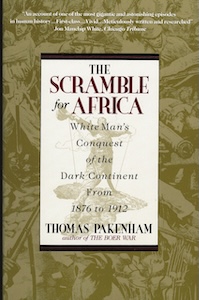
This book covers the history of the colonization of the African continent by European nations from 1876 to 1912. During this period of less than 50 years, Africa was divided at will, mostly by England and France.
The Germans were initially out of it, but eventually started making claims, especially in East Africa. The Belgians were mostly thrown in by their King Leopold via the Congo. The Italians also made some claims in East Africa and Libya. We know the Portuguese colonized Angola and Mozambique but interestingly there’s no mention to them in this book.
I found it pretty hard to summarize this book since it covers so many events of so many countries (I counted at least 30). I’ll just provide some broad themes that I found particularly memorable.
Protagonists
I find that history books that center around individuals a lot more engaging. This book explores that by focusing on a few explorers. David Livingstone was a Scottish physician and missionary. He was one of the first explorers to Africa and opened up the way for subsequent explorers.
Henry Stanley was part of one of Livingstone’s expeditions and he later explored central Africa much further.
King Leopold of Belgium wanted a colony for himself, and failing to buy colonies from other powers, he decided to hire Stanley to “discover” some new territory and claim it for himself. He eventually settled on the Congo. The capital of the Democratic Republic of the Congo, Kinshasa, was called Leopoldville.
Leopold also hired the Frenchmen Pierre de Brazza. Though they’re working for the same man, Brazza and Stanley were racing to see who could get to what was then known as Stanley’s Pool (now Pool Malebo).
Brazza had French interests in mind and this led to territorial claims between France and Belgium. This helps explain the division between Republic of the Congo (French) and the Democratic Republic of the Congo (Belgium). The capital of the Congo is Brazzaville, just across Kinshasa.
The book doesn’t spend as much time on Emin Pasha, but I found him very intriguing. He was a physician from Germany who travelled everywhere, and somehow ended up in Equatoria (in today’s South Sudan) and became the governor. He had to flee the Mahdists rebels, but survived, eventually being rescured by a British expedition led by Stanley. Once he was brought to safety in Tanzania, he deserted and joined the Germans in expeditions in East Africa, during which he was assassinated.
The British Cecil Rhodes became rich due to diamond mines in Kimberley, South Africa. He also pushed for the expansion of the South African colonies to the North, and eventually founding Rhodesia (now Zambia and Zimbabwe).
–
I’ve grouped events into five main threads during this time, roughly corresponding to larger regions in Africa. I cover them next.
Southern Africa
In Southern Africa the main theme was the struggle between the Dutch Boers vs. the English colonists. The book covers the First and Second Boer wars. The main theme from these seems to be that the British had the upperhand, but underestimated the Boers and lost major battles.
A similar pattern occured between the British and the Zulus, in the Anglo-Zulu War. A massive defeat of the British happened at the Battle of Isandlwana.
Part of this Southern Africa thread is the expansion to the North, led by Cecil Rhodes. He initially wanted to connect the British colonies from South to North (Cape-to-Cairo). He didn’t accomplish that goal, but ended up claiming Rhodesian territory (by duping local chiefs) because he believed there was gold mines in the region.
Completing the partition, the British also made Bechuanaland (Botswana) its protectorate and Germany colonized Namibia.
Central Africa
The main theme in Central Africa was the race to conquer to Congo basin. The dispute was mainly between the Belgian king Leopold (mostly in personal capacity) and the French.
The Belgian territory eventually became DRC, Democratic Republic of the Congo, while the French Congo was named French Equatorial Africa, which comprises today’s Chad, Gabon, Republic of the Congo and Ubangi (now called Central African Republic).
The desire to control the Congo basin was that in the early 1900s, Dupont invented pneumatic tires for bicycles and demand for rubber skyrocketed. The Congo had a lot of rubber plantations.
North Africa
In North Africa the major events were in Egypt where the British and French, who were initially backing the Khedive, vassal of the Ottoman empire, started competing for influence. One of the motivations was control of the Suez canal, which started operating in 1869.
The British also feared that any other nation would control the mouth of the Nile (in Lake Victoria), so they spent significant resources to fight the French and German for control of that region. The major opposition to stability in Egypt were the Mahdi rebels, who were operating in Sudan.
France got the shorter end of the stick in Northeast Africa, but it got colonies in the Northwest including Morocco, Algeria and Tunisia. Italy eventually got Lybia and Spain took Western Sahara.
East Africa
In East Africa the British were competing mainly against the Germans. The Germans founded the German East Africa which comprises today’s Tanzania, Burundi and Rwanda. The British controlled Kenya and Uganda.
In Ethiopia, the Mahdist rebels killed the king Yohannes, in the power vaccuum Italy invaded Ethiopia. The new king Menelik, supported by the French, fights back against the Italians.
West Africa
The British had interest in West Africa due to the trade of palm oil. They had a base near Lagos, Nigeria. They also controlled ports in Ghana (known then as Gold Coast), Sierra Leone and The Gambia.
They were mostly competing with the French and were both trying to control the Niger river, since that was the main way goods from inland made to the ports. France claimed a lot of terriority in West Africa, including Mali, Senegal, Guinea, Ivory Coast and Burkina Faso.
Germany claimed Cameroon and Togo.
Conclusion
This book provided an excellent overview of the scramble for Africa. One thing it wasn’t clear to me was which territories were already controlled before the scramble started and to which current borders some of the regions discussed correspond to today.