kuniga.me > Books > The Almanack by Naval Ravikant
The Almanack by Naval Ravikant
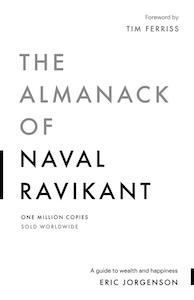
This is a compilation by Eric Jorgenson of thoughts of Naval Ravikant, based on his tweets and podcast interviews.
The book is divided into two parts: wealth and happiness.
Wealth
The general theme of his thoughts is how to become rich by making more efficient use of your time.
Time
He suggests becoming an entrepreneur:
You won’t get rich by renting out your time.
Especially when your time cannot be objectively valued, you have to be the one driving it up:
You will never be worth more than you think you are worth.
I completely disagree with this statement. Maybe a more nuanced take would be that you can increase your value by evaluating yourself higher. On being efficient:
I just want to be the most successful version of myself while working the least hard possible.
Making the best of your time:
If you’re not spending time doing what you want or you’re not earning or you’re not learning, what the heck are you doing.
Pleasing people:
Don’t spend your time making other people happy.
Decision Making
Prioritization:
If you can’t decide, the answer is no.
Choosing between options with different short term and long term tradeoffs:
A simple heuristic: if you are evenly split on a difficult decision, take the path more painful in the short term.
This seems like the other side of delayed gratification. Another bit on this topic:
Dopamine is trading short term happiness for long term happiness.
Recognizing procrastination:
When you say “I’m going to do this”, “I’m going to be that”, you’re really putting it off.
and motivation:
Inspiration is perishable. When you have inspiration, act on it right then and there.
Knowledge
Or having unique/useful knowledge:
Specific knowledge is knowledge you cannot be trained for. If society can train you, it can train someone else and replace you.
Similar in spirit:
Being at the extreme in your art is very important in the age of leverage.
The book constantly mentions focusing on mastering basic disciplines:
Study microeconomics, game theory, psychology, persuasion, ethics, mathematics and computers.
Learning:
The means of learning are abundant. It’s the desire to learn that is scarce.
On reading:
Reading is faster than listening. Doing is faster than watching.
I agree with both points, but I don’t know if everyone would agree with the first. Still on the topic of reading, Naval says he reads multiple books at the same time and doesn’t finish reading books:
Some books just have one thing to say and the rest is just examples and more examples.
I can definitely relate to this, especially with psychology books (e.g. Grit by Angela Duckworth, Quiet by Susan Cain, Range by David Epstein). I think being unable to not finish a book is a handicap of mine.
Not all knowledge is equal:
Some people read a lot but are not very smart. Because they started with the wrong foundation and they judge/ consume new ideas with respect to that foundation.
Relatedly, on having flawed believes:
Any belief you took in a package (e.g. Democrat, Catholic, American) is suspect and should be reevaluated from base principles.
Competition
He thinks that one should avoid competition:
When you’re competing with people you’re copying them.
This is similar in spirit to what I read in The Code Breaker where Doudna’s advisor is quoted saying:
Never do something that a thousand people are doing.
Another quote, on competition for competition sake:
Status is a zero sum game. Wealth creation is a positive sum game.
Happiness
Naval’s philosophy on happiness seems to be aligned with Stoicism and Buddhism.
Living in the Present
Happiness is the state when nothing is missing, when your mind shuts down and stops running into the past or future to regret something or to plan something.
A quote from Homer, from the Iliad:
Everything is more beautiful because we’re doomed. You will never be lovelier than you are now and we will never be here again.
A quote from Confucius:
You have two lives and the second one begins when you realize you only have one.
Desire
Desire and unhappiness:
Desire is a contract you make with yourself to be unhappy until you get what you want.
A very Buddhist take:
Happiness to me is mainly not suffering. Not desiring. Not thinking too much about the future or the past.
The two parts of the book might be at odds with each other:
Happiness is being satisfied with what you have. Success comes from dissatisfaction. Choose.
This is perhaps a more nuanced version of “Money doesn’t bring happiness”. A more balance view for mortals:
Pick one big desire in your life at any given time to give yourself purpose and motivation.
On sticks and carrots:
90% of thoughts I have are fear based. The other 10% may be desired based
More of fear-driven behavior:
The word “should” come from guilt or social programming.
Interesting take:
Hedonic adaptation is more powerful for man-made things.
Whenever I read that we are not adapted to our modern lifestyle, I think mostly nutrition and sedentarism, but I think stimulus and incentives make a lot of sense too.
Being Nice
He provides some motivation to not just being nice to people externally, but also internally because:
Judging makes you feel good in the moment but may lead to see negativity everywhere.
I don’t know if this is true but I think judging people has almost no upside, so I’m willing to believe it has downsides, to avoid spending mental energy on this.
Death
There is no legacy. There’s no purpose, it’s just a game you can make fun.
This is very stoic.
Health
When everyone is sick we no longer consider it a disease.
I think about this a lot, how humans are good at normalizing problems they can’t easily deal with. Perhaps this will be our downfall.
Avoid food invented in the last 100 years.
I find nutrition borderline pseudo-science because it’s so hard to isolate cause and effect. That said, this take makes sense to me, just from the survivorship bias perspective. Food that has been consumed for 100 years have been evaluated more for long term side-effects.
Philoposhy
I’m not religious. I’m spiritual to me. That is the most devotional thing I can do to study the laws of the universe.
Conclusion
I read this book in 4 days. I don’t remember the last time I read a 200+ page book this fast. Partly because the physical layout of the book is not dense (lots of white space) and there are many ideas that are repeated in different ways.
The other reason for finishing fast is that I find Naval’s writing compelling, especially because I agree with many of his takes. But also a lot of his content are aphorisms, distilling wisdom in concise form, like the ancient Greek philosophers, Buddha and Confucius. It’s no wonder that he became popular via Twitter.
I found some of the content thought provoking, some made me see things I already knew or agreed with in a different light and some was just reinforments. But I don’t think any of it is life changing, though it reminded me of being more cognisant of my time.
Naval is a successful person, and we have to take advice from successful people with a pinch of salt. There’s no way to prove that he got where he got just by following the principles laid out in this book. Of course the book doesn’t mention this, but it does cover general the priciple which it calls falsifiability, which basically means we cannot run A/B test with history.