Ficciones
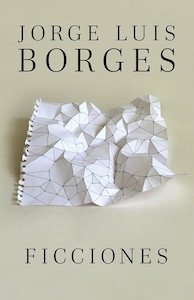
This book is a collection of 16 short stories by Jorge Luis Borges. I read the Spanish version of the book. A common theme of them is that they’re meta stories. Some of them plays with time and causation, others with infinity, recursion and self-reference. Some are highly philosophical.
In the remainder of this post I share my notes on my favorite stories. It has spoilers.
Pierre Menard, autor del Quijote
The gist of the story is that the character Pierre Menard attempts to translate Don Quixote to French with such high fidelity that he ends up with a text that is the exact copy of the original in Spanish.
He claims his version is better because of the historical context on which it was “written”. Wikipedia has a nice analysis about this story, in particular around attributing meaning and value to texts.
Las Ruinas Circulares
This story is about a guy who dreams of another man in a temple and later realizes he himself is a dream of someone else.
This recursive dream evokes the movie Inception and according to Wikipedia it inspired Christopher Nolan in writing the movie.
La Lotería en Babilonia
In this story a lottery company starts to run lotteries to decide the fate of people beyond monetary rewards, for example, whether someone is sentenced to death or not.
Increasingly it’s used to decide to decide the outcome of everything, even for events not related to people (e.g. natural events). It also starts being secretive so people are not aware of the lotteries. Slowly it morphs into chance itself.
La Biblioteca de Babel
This is my favorite story. It’s about a library that contains every possible text that can exist, including garbage with random letters. I want to read / think more about this.
El Jardín de Senderos que se Bifurcan
This is my second favorite story. It plays with the idea of the multiverse where all possibilities exist.
Funes el Memorioso
Is the story of a guy who can remember everything in detail. It explores the consequences of such capability. An interesting one is that he is unable to generalize or think abstractly because he can remember all the instances.
He also comes up with a number system to identify things since he remembers so many of them that they don’t have proper names. It reminds me of Gödel numbering.
El Milagro Secreto
This is an interesting story of a guy who is about to be executed and asks God for one more year. He grants him it by stopping time at the very last second of his death, but he stays conscious and paralyzed for a whole year!
This story also touches on the anxiety of an event you know it’s about to happen but you don’t know the details and then spend time imagining several possibilities. At some point the character claims that once you imagine an outcome this means it won’t happen since it’s unlikely that you’re able to predict the future. So he tries to think of the worst possible outcomes to make sure they won’t occur.
Conclusion
I had trouble following some of the logic from the stories, especially those with a deeper philosophical character, such as Tlön, Uqbar, Orbis Tertius which after reading Wikipedia I learned refer to the theory of subjective idealistm by the philosopher George Berkeley.
It didn’t help that I read the book in Spanish, which I’m not very fluent in. I can understand about 90% of the words just by their similarity to Portuguese, but often times I found the 10% made it hard understanding the meaning of the phrase.
Other times I thought I knew all the words but still couldn’t understand the sentence because they were used with meanings I’m not used to. Example:
El destinaba esa habitación a un empleo que el adivinó.
I can tell the verb destinaba might mean “send towards a destination” but more metaphorically it means to “designate” or “use”. The verb adivinar usually means “guess” but here it’s more like “conjure” or “create”. So this phrase means:
He used this building for a job he had created.