kuniga.me > Books > Fire in the Lake
Fire in the Lake
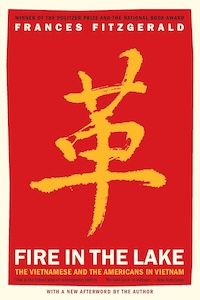
If I had to summarize this book in one paragraph I’d say that it tries to explain why the US lost the Vietnam war. And if I had to summarize the answer (as provided by the book), I’d say it’s because Americans didn’t understand the Vietnamese society and assumed a false dichotomy between the North and South.
It covers only briefly the history of Vietnam, mainly to set context but it also details what was going on behind the scenes during the war days. A great portion of the book is dedicated to analysis of the Vietnamese society and criticism of the policies of the Americans during the war. The theories are interesting, but hard to take with any degree of objectivity. It doesn’t cover much of the war front and it seems to assume prior knowledge of it, possibly because Americans are supposed to have learned about it in school.
Next I’ll cover some topics I found particularly interesting. I won’t delve much on the history itself, and instead incorportate whatever I learned from this book into my History of Vietnam notes.
North vs. South
A common misconception of the war is that the US was helping the South against the North. This is clearly expressed in the passage:
(…) the Vietnam War was not a civil war; it was a revolutionary war that had raged throughout the entire country since 1945.
NLF
The National Libration Front or NLF, known in the west as the Viet Cong, was seen by the West as a puppet organization of Hanoi, but they’re largely independent:
The personnel of the NLF was, with few exceptions, southern.
The author suggests that the NLF was created as a rection to Ngô Đình Diệm’s terror regime, the autocratic president of the South put in power with American support.
The NLF had an interesting organization structure. For example, to gain more power, a member of NFL needed to join the party, a move inwards, which required more sacrifice. This reminds me of the concept of “skin in the game”.
Another organizational aspect of the NLF was the Khiem thao (meaning to verify or discuss). Borrowed from Chinese communists, this was session in which every member of the organization had to participate, having to admit their own failings and provide feedback about peers in a safe environment. I read about the Chinese version in the book Wild Swams by Jung Chang, although in her accounts, it was often abused and led to petty accusations.
Confucianism
It seems impossible to talk about China and Vietnam without mentioning Confucianism. In the same way the book Imperial China: 900 - 1800 by F. W. Mote does for Chinese society, a great deal is spent by FitzGerald in explaning the Vietnamese society throught Confucianist lens.
The author also suggests that Confucianism and Communism have a natural affinity, and how the latter is different from the Western Communism that was being practiced in the Soviet Union.
The familiarity of the Communist language was in many ways a deception, for the Vietnamese were not like the Russians or the East Europeans
In its relation to China, the author says:
Given the geographical and cultural proximity of Vietnam to China, it is perhaps understandable that the two major historical changes within Vietnamese society — the building of a Confucian state in the tenth to eleventh centuries and the Communist revolution in the twentieth — should follow the same pattern.
The Invidual
Another aspect of Confucianism is the individual being less centered on themselves and more part of the larger society.
The moral problem for the individual was to discover not what he himself thought or wanted, but what the society required of him. The goal of speech was less to express the individuality of the ego than to arrive at a harmonious relationship with others and with the laws of the universe
As an argument, the author says that the word for I in Vietnamese is tôi, and that had the conotation of “subject of the king”. In general, it does seem true that Vietnamese pronouns are relational. According to Wikipedia:
In Vietnamese, a pronoun usually connotes a degree of family relationship or kinship. In polite speech, the aspect of kinship terminology is used when referring to oneself, the audience, or a third party.
Buddhism
Buddhism coexisted with Confucianism. The buddhists tended to be more active and vocal as opposition. I found this quote interesting:
The Vietnamese are Confucians in peacetime, Buddhists in times of trouble.
Vietnamese Society
The Village
Great emphasis is given to how Vietnamese society was organized around the rural village. These are generally self-sufficient (resource-wise but also administration-wise):
In Vietnam it was the village rather than the clan that stood as the primary community.
And isolated from each other:
The village was an independent and isolated unit - it’s very suitable for guerrilla warfare.
This made it particularly hard for the colonizers (Chinese, French and Americans) to exert major control over rural Vietnam.
The author claims that the NLF used non-violent tactics to win over the villages. They sent representatives (cadres) that lived in the village and mingled with the locals. The strategy used by the Southen government was by sending some sort of police that often led to abuse of power.
Colonizers
On French colonization:
Like many Americans in the twentieth century, the French conquerors truly believed they were helping the Vietnamese by occupying their country.
The author suggests that it was the French colonization that started disintegrating Vietnamese society, not Diem, not capitalism.
American Dependency
Americans often criticized the government from the South as ineffective and corrupt. On the words on general Ky (one of the many leaders that succeeded Diem) against corruption:
He would have preferred to run an honest government than a corrupt one. The only difficulty was that his power depended upon corruption.
This reminds me of the system trap Shifting the burden to the intervenor discussed by Donella Meadows in Thinking In Systems.
Another aspect of it is that many in Southern Vietnam despised the Americans but were dependent on them. According to the author this led to:
The situation was therefore a most curious one: the Americans dominated the GVN [South government] but could not make it work for them.
Psychoanalysis
The author often treats the Vietnamese as a single consistent individual and tries to understand them as a psychologist might an indivudual, with the usual wild interpretations:
(…) the guerrillas were attempting not to restore the old village but rather to make some connection between the world of the village and that of the cities. The land mine was in itself the synthesis.
Having themselves manufactored a land mine, the villagers had a new source of power — an inner life to their community. In burying it — a machine — into the earth, they infused a new meaning into the old image of their society.
But at least there’s recognition of the subjectivity of these ideas:
But because the social scientists can rarely attain the same criteria for “truth” as physicists or chemists, they have sometimes misused the discipline and taken merely the trappings of science as a camouflage for their own beliefs and values.
The author also borrows from Shakespare’s The Tempest, to explain the complicated relationship between colonizer (Prospero) and the colonized (Caliban). Caliban resents Proposero but believes he can’t survive without him.
In a sense, then, it is the colonial and not the native who is a “child,” for his desire to escape rises out of the sense of insecurity and inferiority he felt within his own culture. In the native he finds a fulfillment of his childish dreams of domination and an object (for the native is to him an object) upon which to project all his repressed desires.
And if there’s any doubt there’s psychology in this book:
As anyone with a knowledge of Freud might suspect, it had something to do with the relationship of the Vietnamese child to his father.
Conclusion
This book reminds me a lot of Formosa Betrayed by George Kerr, which covers the few years in Taiwan after WWII. It covers a similar period and timestamp, the chaotic times after the end of WWII and Japanese evacuation; A struggle for power between communism and capitalism; US supporting a largely unpopular leader; Authors highly critical of the American policies.
I bought this book for a trip to Vietnam, but after reading it, I decided to stop using books to learn about a country’s history. I’m better off reading Wikipedia. I will still read books covering history in unique angles and perhaps might even have enjoyed this book more if I had a different set of expectations.
One question that left me curious is why the outcome of the Korean war was different from that of Vietnam? One would think of similar Chinese culture influence in Korea. I don’t know anything about Korean history, so this is a topic of interest now.