kuniga.me > Books > The Man from the Future
The Man from the Future
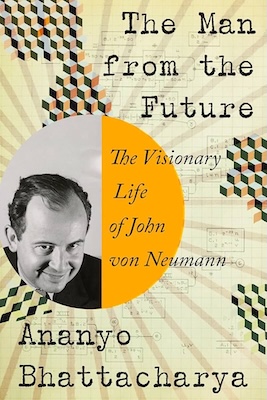
The Man from the Future: The Visionary Life of John von Neumann is the biograph of von Neumann by Ananyo Bhattacharya. He explores von Neumann’s life but focuses on the scientific ideas pioneered by this polymath.
This includes: quantum mechanics, the atomic bomb, the modern computer, game theory and automata.
Instead of summarizing the contents of this book I’ll cover topics or ideas I found interesting or personally relatable.
Environment. von Neumann is no doubt one of the smartest men ever to walk on earth, but I found interesting that his upbringing in Hungary also maximized his potential. He was from a well-off family that encouraged education and had private tutors.
Von Neumann was also jewish and there was concerns about the tolerant climate in Hungary towards them might change. According to the book:
Physics and mathematics were safe choices for Jews who wished to excel: an academic career could be pursued in many countries (…)
Hilbert Spaces. von Neumann was mentored by David Hilbert while studying at the University of Göttingen. He was the one who saw a broader application of this theory and coined the term Hibert Spaces.
von Neumann Algebras. Is a theory he worked on while studying quantum mechanics. The mathematician Vaughan Jones was awared the Fields medal in 1990 for his work based on this theory.
Gödel’s Incompleteness Theorems. Von Neumann was friends with Einstein and Kurt Gödel. It’s possible that that von Neumann had proved that math is incomplete based on Gödel’s early works, but Gödel published it first.
Gleb Wataghin. This name caught my attention because the Physics institute in my University (Unicamp) was named after him. He helped creating the department of physics at the University of São Paulo in Brazil. He was friends with von Neumann.
Game Theory. Von Neumann is one of the founders of game theory and coined the term zero sum game. He also developed the minimax theorem.
Linear Programming. George Dantzig considered to be the father of simplex algorithm reached out to von Neumann for help. Von Neumann lectured him on the mathematical theory of linear programs.
He saw parallels between linear programs and the minimax theory. He knew about the primal-dual relationship and their optimality. So it isn’t too far to conclude he contributed significantly to the development of the simplex algorithm.
Nash equilibrium. John Nash presented his most known result to von Neumann, who initially dismissed it as trivial. His main objection was on the axioms Nash theory assumed.
According to the book, Von Neumann’s game theory basis was on European principles where collaboration was beneficial even if people were trying to maximize their own. Nash’s is the more American, individualistic.
Automata. Von Neumann came up with the idea of self-replication before DNA was well known and understood. He also came up with the idea of cellular automata. It was a more complicated version than John Conway’s game of life.
John McCarthy (who conined the term Artificial Intelligence and was one of the study pioneers) attended one of von Neumann’s talk about automatons and sent him a letter with some ideas.
While von Neumann wasn’t involved in the field of Artificial Intelligence, he saw value in getting inspiration on how the brain works based on the works of Warren McCulloch and Walter Pitts. Also according to Ray Kurzweil:
Prior to von Neumann, the fields of computer science and neuroscience were two islands with no bridge between them.
Pascal Wager. Von Neumann’s family was from a Jewish background but to avoid persecution they converted to Catholicism. However, for most of his life, Von Neumann was non-religious. He changed his stance when he realized his end was near. According to his daugther he said:
Catholicism was a very rough religion to live in but it was the only one to die in.
Quotes
Not attributed to an individual but mathematicians around him were supposed to say:
Most mathematicians prove what they can, von Neumann proves what he wants.
von Neumann:
If people do not believe that mathematics is simple, it is only because they do not realize how complicated life is.
Chris Langton:
By the middle of this century, mankind had acquired the power to extinguish life on Earth. By the middle of the next century, he will be able to create it. Of the two it is difficult to say which places the greater burden of responsibility on our shoulders.
Conclusion
This book provides a good overview of von Neumann’s life and the many areas that have his fingerprints. It reminds of Walter Isaacson’s biography of Jennifer Doudna, which is part biography and part the history of CRIPR.
I enjoyed most of the book, except for the chapters on Game Theory and the RAND which I found a bit tedious.