kuniga.me > Docs > History of South Africa Cheatsheet
History of South Africa Cheatsheet
Index
- Early History
- Pre-European
- Zulu
- European Colonization (1652-1910)
- Union of South Africa (1910-1961)
- Apartheid (1948-1994)
- Democracy (1994-)
- Related Books
Early History
Like other countries in Southern Africa: Botswana, Namibia and Zimbabwe, in early history the region was inhabited by the San people.
Around 2,000 years ago, the Bantu-speaking people from the North arrived from Central Africa, and are likely the ancestors of many of the modern population such as the Zulu, Xhosa people, the Sotho-Tswana, Venda and Tsonga.
Pre-European
Before European contact there was a diversity of groups of people. On the east side of South Africa were the Nguni. They were subdivided into groups such as the Zulus, Xhosa and the Swazi.
The Swazi are today concentrated in the country of Eswatini which used to be called Swaziland. And the Xhosa are concentrated in the Eastern Cape province.
In the central plateau, which includes today’s Botswana, were the Sotho-Tswana. This group includes the Basotho people who today live in the country of Lesotho. The Tswana today are concentrated in the North West Province and Botswana.
The Venda were settled around the Soutpansberg mountains, in today’s Limpopo province where they’re still concentrated. The Tsonga were settled near there, but more towards the coast, and today are spread across the Limpopo and Mozambique.
The west side of South Africa was inhabited by the hunter-gatherer San people and the semi-pastoralist Khoikhoi. The Bantu people did not settle there.
Zulu
Shaka Zulu (r. 1816-1828) was a powerful Zulu king who centralized authority via conquests with a disciplined army. He’s credited with causing the Mfecane (scattering in Nguni) that led to mass migration in Southern Africa. But it’s likely that many warlords were consolidating power and fighting each other, causing disruption.
In the process, a general under Shaka, Mzilikazi, broke away and fled Northwards with his followers. They formed a new identity and called themselves Ndebele. Today they live in the province of Mpumalanga and in southern Zimbabwe. The Zulus inhabit the province of KwaZulu-Natal.
European Colonization (1652-1910)
Portuguese
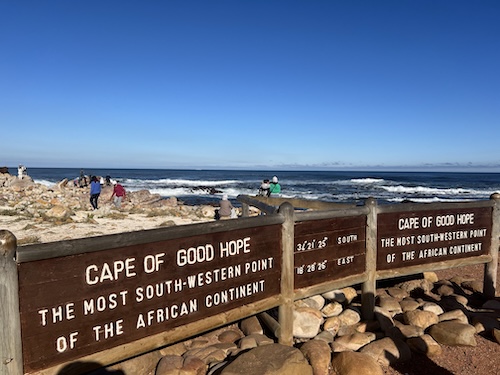
The Portuguese are the first known Europeans to have reached South Africa, in 1488. In particular Bartolomeu Dias sailed from Lisbon to the Cape of Good Hope which he then called the “Cape of Storms”.
Later Vasco da Gama went further, from Lisbon to Calicut (Kozhikode) on the Malabar Coast of India by circumnavigating the African continent. During the voyage, he reached the east side of the South African coast during Christmas and named it Natal (Christmas in Portuguese). The name survives today as the province of KwaZulu-Natal.
Dutch
The Portuguese didn’t settle in South Africa. The Dutch were the first Europeans to do so. In 1652, as a member of the Dutch East India Company (VOC) Jan van Riebeeck established a settlement in Table Bay (modern Cape Town).
It was meant to be a refreshment station for the long navigation from Europe to India, but it evolved into a colony. They allowed farmer colonists and also brought slaves from their other colonies including East Africa, Madagascar, Indonesia and India, who were known as Cape Malays. This displaced the local population of San and Khoikhoi.
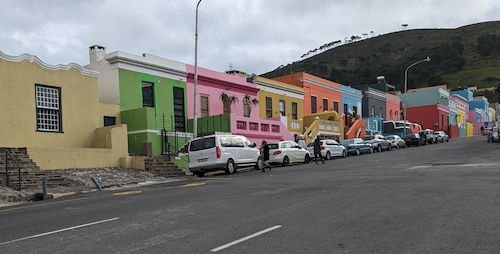
The neighborhood of Bo-Kaap was initially built by a Dutch settler to house his slaves from Southeast Asia.
Boers
The early settlers expanded inland in search of more pasture land. They were semi-nomadic pastoralists and became known as Trekboers. As they pushed forward they came into contact and conflict with the Bantu people, in particular the Xhosa. This expansion process happened gradually during the 1700-1800s and these conflicts are grouped into the Cape Frontier Wars.
With time these Dutch settlers started to build their own identity, and became known simply as Boers. Their language became known as Afrikaans which today is partially intelligible with Dutch (on the level of Portuguese and Spanish).
British
The British first took the Cape from the VOC during the Revolutionary Wars. The Netherlands sided with France and Britain wanted control of the sea route. In 1814 the Netherlands formally ceded the Cape to the English (as part of the Anglo-Dutch Treaty of 1814). The English by then were a stronger naval power and had the upper hand over the Dutch.
The British renamed the settlement Cape Colony and made changes such as the abolition of slavery (1834), introduction of the English legal system and expansion eastwards.
The Great Trek (~1830-1840). As the British took control of Cape Colony, the Dutch settlers (also known as Voortrekkers) migrated en masse to the East (1830s and 1840s). They founded colonies such as Natalia, Transvaal and the Orange Free State.
In Natalia they came into conflict with the Zulus, led by the successor of Shaka, Dingane. The Boers defeated the Zulu in the Battle of Blood River (1838) and gained control of the region, but lost it to the British a few years later in 1843.
Indians (1860-). As they expanded, the English brought indentured laborers from their colony in India to work on sugar plantations in the Natal colony. That’s why today there’s a large community of Indian descendants in cities like Durban. Mahatma Gandhi arrived in 1893 as a lawyer, but was thrown off the train despite having a first-class ticket. This helped turn him into an activist who organized the Indian community. He developed his philosophy and methods (satyagraha) during this period that were later used to lead India towards independence.
The Anglo-Zulu War (1879). As the British pushed east, they came into conflict with the Zulu, then led by Cetshwayo. The British suffered a shocking loss at the Battle of Isandlwana, considering that the Zulu did not possess firearms. This led Britain to send a larger army that eventually won a decisive battle at Ulundi and broke up the Zulu kingdom into smaller chiefdoms.
The First Boer War (1880-1881). In 1877 the British annexed the Transvaal. The Boers revolted and won a decisive battle against the more powerful British at the Battle of Majuba Hill, and were able to maintain independence in the Transvaal.
Cecil Rhodes (1853–1902). A British imperialist, born in 1853 in England, who immigrated to Cape Colony in 1870. This was around the time when diamonds were found in Kimberley. He eventually bought out competitors and in 1888 founded the De Beers company. At its peak the company had a near monopoly in diamond mining in South Africa and controlled 80% of the diamond trade worldwide.
He had the vision Cape to Cairo, which would expand the British empire by connecting these two colonies by land. He founded the British South Africa Company which eventually led to the colonization of Rhodesia (today’s Zambia and Zimbabwe).
Second Boer War (1899–1902). In 1886 gold was discovered in Witwatersrand (in the Transvaal) which led to conflict between English and Boer settlers, escalating into a bloody war, which the British eventually won and as a result took control over the entire Boer republics including the Transvaal and the Orange Free State.
The book The Scramble For Africa covers these battles in detail.
Union of South Africa (1910-1961)
In 1910, after the Second Boer War, the British brought the Cape Colony, Natal, Transvaal and Orange River Colony under one government, the Union of South Africa. This government was run by a white minority. It was subject to the British Crown, but was largely independent like Canada and Australia at the time.
To balance powers, the executive, legislative and judiciary capitals were split across the country: Pretoria, Cape Town and Bloemfontein, respectively.
In 1913 the Native Lands Act was passed which limited land ownership to lands called native reserves which comprised less than 10% of the country’s land. It’s regarded as the foundation for apartheid.
During World War I, South Africa fought on the side of Britain. One of the major outcomes was the invasion of German Southwest Africa in 1915. South Africa held control of it until 1990 when it became the independent country of Namibia.
After losing the Second Boer War, many Boers became poor and resented the British and the black South Africans. They started unifying around an Afrikaner identity which led to the creation of the National Party in 1915. Also one of the two official languages changed from Dutch to Afrikaans.
Apartheid (1948-1994)
The National Party went through a few mergers with more moderate ones, becoming the United Party, but the hardliner Afrikaner nationalists led by D. F. Malan rejected these and decided to form a Purified National Party, which was still referred to as the National Party.
The party was elected in 1948 and started the policy of apartheid (apartness in Afrikaans). This policy divided people into whites, blacks, coloured (mixed race) and Indians. It required non-whites to carry passbooks.
It also created the bantustans, territories to segregate ethnic groups. For example Transkei (Xhosa), KwaZulu (Zulu), Bophuthatswana (Tswana). It forcefully relocated people there.
Nelson Mandela was from the Transkei (born in 1918, before the Apartheid), from a royal family from the kingdom of Thembu (part of the larger Xhosa people).
He was a lawyer in Johannesburg, then became a member of the ANC (African National Congress). His original tactics emulated those of Gandhi (Satyagraha, peaceful civil disobedience) but later changed to armed struggle, founding the military wing of the ANC, MK (short for Umkhonto we Sizwe or “Spear of the Nation”) which carried out sabotage.
He was arrested in 1962 and spent much of his prison time on Robben Island, just off the city of Cape Town. In 1990 he was released. Mandela’s life is described in detail in his autobiography Long Walk to Freedom.
In the 1976 Soweto uprising, students protested apartheid and police opened fire on them, with hundreds of casualties. This made the news internationally and is considered a turning point. The world started to increasingly pressure South Africa to end apartheid, imposing sanctions and isolating it politically.
This led to a change in position of the leader of the National Party, F. W. de Klerk, who eventually agreed to the end of apartheid in 1990, democratic elections and the release of Nelson Mandela, who would later be elected president in 1994.
The comedian Trevor Noah was born during Apartheid as the son of a white father and black mother, and recounts his experience growing up in Johannesburg in the memoir Born a Crime.
Democracy (1994-)
The transition was peaceful, in large part thanks to Mandela and de Klerk. Today South Africa continues to be one of the most developed countries in Africa, but still deals with the legacy of segregation, and suffers from inequality, corruption and unemployment.