kuniga.me > Books > Metaphysics
Metaphysics
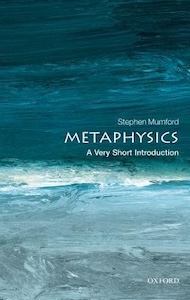
Metaphysics: A Very Short Introduction is a book by Stephen Mumford. Each chapter aims to answer a question:
- What is a table?
- What is a circle?
- Are wholes just sums of parts?
- What is a change?
- What is a cause?
- How does time pass?
- What’s a person?
- What is possible?
- Is Nothing Something?
- What is Metaphysics?
Before we go over each in more detail, one thing I dislike about many metaphysics discussions is that a lot of it seems to be language artifacts or subjective interpretations, or more formally semantic (meaning we give to things) vs. ontological (what exists). For example when we ask Does this table exist?, to me its constituting atoms are there and they’re arranged in a particular way. Whether we consider it an object and call it table is semantic, and doesn’t tell us anything about reality.
Summary
Particular and Properties
In What is a table? the author talks about particulars and properties. He says we can only experience things through their properties (e.g. shape, color), but properties can change (e.g. a brown table can be painted red) so it’s hard to define exactly what a thing is. One option is to define things as a bundle of properties but then how do we distinguish different things with the exact same properties?
As a programmer I found an interesting analogy between classes and instances. Two instances might have the exact same properties but are different instances.
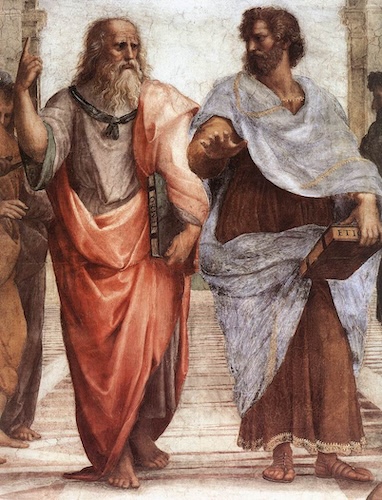
Plato’s Heaven
In What is a circle? he considers whether properties exist in our real world. He mentions Plato’s heaven or the realm of ideas and properties as a separate realm from the real world.
I’m much more interested in this topic, mainly whether properties exist without particulars. One argument for it is if you destroy all circular things, the idea of a circle will still exist. I personally believe the real world is Plato’s heaven, inspired by Our Mathematical Universe and Permutation City . In fact, I wanted to learn more about metaphysics to develop these ideas further.

Particles and Emergent Behavior
In Are wholes just sums of parts? he talks about two interesting ideas: whether there is the smallest particle or it’s turtles all the way down, and about emergent behavior, i.e., how can we get a complex organism from “dumb” molecules. I’m very interested in emergent behavior.
Time
What is a change? focuses on identity at different times. Am I the same “thing” as yesterday? There are two competing views here, endurantism and perdurantism. Endurantism thinks an object remains the same but its properties change. Perdurantism thinks that objects at different times are different instances. There’s also exdurantism but I think it’s just endurantism in disguise.
I have thoughts on this, shared with Permutation City, in which our reality is more like frames in a movie or a point in 4D. However, I find the debate between endurantism and perdurantism also more semantic than ontological.
I’m very interested in time! The chapter How does time pass? presents some discussions such as whether only the present exists; that the past feels more real than the future due to relativity / speed of light (e.g. when we observe events far away in the universe we’re witnessing something that happened in the past); whether time goes on “forever” or it’s somewhat circular.
There’s a view called eternalism which I subscribe to, which believes all events across time are real. This sees time as a 4th dimension and that at any given time we’re at a point in it, but that this 4th dimensional world “exists” already.
Causation
I always associate the question of causation to Hume. That’s the only thing I remember from him. In What is a cause? it does bring him up. This quote summarizes my main issue with metaphysics:
Everything a realist says about causation one can translate into Humean terms about the pattern of events. It then becomes harder to even articulate the difference between Humeans and their opponents.
That is, sometimes opposing views are just framing things differently or using different words.
I think about causation often in terms of attribution (did person X really cause outcome Y?) and relatedly the counterfactuals (if person X didn’t do anything, would Y happen?). But I think this is not metaphysical. This is about understanding causes in complex environments. The question philosophers ask “If I push a ball and it moves, was I the one causing it to move?” is not very interesting to me.
Consciousness and Identity
In What’s a person? some topics cover whether humans and other conscious animals have souls, in which case how does the soul-body interface work? It touches again on the topic of real world vs the realm of ideas and emergence (can consciousness arise from a physical brain). He talks about identity which to me is also similar to what was discussed in What is a table? and What is a change?.
I think a lot about identity but more on a psychological level. For example: if my brain started working differently tomorrow but I retain my memories, would I feel like I’m a different person? This also matters in dealing with people who are close to you: if someone you know gets dementia and behaves very differently, are they the same person? Would you treat them the same way?
Possibilities
The chapter What is possible? discusses ways to reconcile the paths not taken. One appealing theory to me is the Many worlds interpretation, which also helps us make sense of quantum mechanics.
Negation
The question Is Nothing Something? to me falls in the realm of semantics instead of ontology and the author concedes that as well, especially because in English you can say “There is no food in the fridge”, which conveys “no food” is something. The major idea I got from this chapter is that Bertrand Russell concluded that we cannot have a logical system that doesn’t include “negation”. I think this is a lot more interesting than whether a hole exists or not.
Metaphysics and Science
In the final chapter, What is Metaphysics?, Mumford concedes that metaphysics is useless in the sense that it doesn’t have practical applications, but perhaps this is by definition. Once it has some practical manifestation it becomes the realm of science. Speaking of science, I like the framing that both metaphysics and science have the same goal (understand reality) but with different methods. Another interesting framing is that metaphysics is a continuum with physics. The more we understand from physics, the boundary between them moves (e.g. the discovery of relativity).
This last chapter was the most interesting to me, especially the comparison with science.
Conclusion
This book helped me be more sure of my view: that I’m only interested in parts of metaphysics, mostly those near the border of physics: time, the smallest granularity of reality, consciousness and many-worlds.
The part I dislike about metaphysics and philosophy in general is that much of it is due to language and speculating about things beyond our mind’s comprehension (see Blind spots in Elbow Room). One thing I’d like to learn more about is the “axiomatization” of metaphysics, treating it more like math. You define a set of basic rules or assumptions and derive theories from it. As the author puts it:
It looks like we only get out of the theory as explanation what we have put into it as assumption.
But I’d like something more explicit/formal. It seems like this is called formal ontology, so it’s something I’m looking forward to exploring.
Book Connections
Besides the books mentioned throughout the summary, here are a few other connections:
In The Music of the Primes it quotes the Platonic view “there exists, independently of the human mind, a raw and immutable mathematical reality…”, the exact debate in What is a circle?.
Hofstadter explore consciousness as a self-referential loop in I’m a Strange Loop. He also talks about identity using the thought experiment of cloning an individual, which is also used by Mumford using Star Trek as background.
In An Immense World Yong introduces the concept of unwelt and how animals perceive our world vastly differently from us. When we talk about consciousness we often need to include “intelligent” animals such as dogs, dolphins, and octopuses. The last one puts question on the link between identity and consciouness: an octopus seems to have independent “brains” on their arms so it’s not a single entity.