kuniga.me > Books > An Immense World
An Immense World
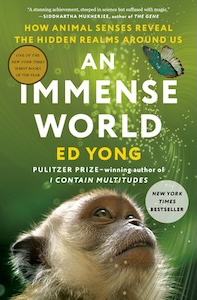
An Immense World is a book by Ed Yong. There’s a famous paper by Thomas Nagel titled What Is It Like to Be a Bat?. Yong takes this idea further and explores what is like to be a number of animals whose sense are so different than ours.
Each of the earlier chapters is dedicated to one of the senses: smell and taste, vision, color, pain, heat, touch, hearing, echolocation, electric fields, and magnetic fields. The second to last chapter is how these senses are not processed in isolation, but rather as a combination (think of synesthesia). The final chapter is a wake up call to human activity inadvertently messing with animal senses.
I started listening to the audiobook a fews back, but found it pretty boring, so never finished. I then got the physical copy as a gift and wasn’t planning to read, but aftere reading Project Hail Mary I decided to give it a try, and I’m happy I did. I enjoyed reading much more than listening to it.
The book introduces the term umwelt (environment in German) as he space of perception of an individual animal or basically the combination of all their senses.
Trivia
Random things I learned from each chapter.
Smell and Taste
- There’s a theory that olfaction developed so animals can move around without getting lost. One example is the polar bear whose glands in their paws leave smell traces in the otherwise indistinguishable now.
- Snakes smell with their tongues, and there’s a theory is that it’s forked so that it’s stereo (why we have 2 nostrils).
- Some insects can taste with their limbs like mosquitoes.
- Many animals can’t taste sweet, including cats. Dogs and pigs can.
Vision
- There’s a measure of eye resolution: cycles per degree (cpd), which is how many stripes can we distinguish in 1 degree of field of vision. Ours between 60-70 cpd. Cats are around 10 cpd, eagles are around 120 cpd.
- Eyes are not always used to see: scallops have hundreds of eyes but don’t make full use of them. Only use them for binary detection.
- Sensitivity (how much light your eyes need to see) and resolution at odds with each other.
- The four eyed fish, which actually as two eyes divided into two functional units, has evolved as such because it lives at the water surface and keeps half its body outside the water.
- Frame rate: killer fly and other insects probably has over 350Hz of FR. We are at 60Hz, cats at 48Hz and dogs at 75Hz. Surprised that cats are lower.
- Exposure: In daylight images make into our brain in 10-20ms while in dim light it takes 50-100ms. This is like exposure in cameras: we need more time to collect enough light. Sweat flies can do it over even longer intervals, 300ms.
- Giant squids has the largest eye by far of any animal, even relative to their size. It’s believed to have evolved to spot its largest predator, the sperm whale, who relies more sonar for “seeing”.
Color
- Opponency: We get input from our cones but need to do some math to combine the signals. Some animals just use them as crude binary sensors for example yellow cone activated = sun.
- It’s theoretized that color developed because an object moving through shallow waters keeps changing brightness but its hue remains relatively stable, so being able to see colors allows detecting objects near the surface.
- Most animals can see UV. Humans cannot because our lens filters it out. When Monet got his lens removed due to a cataract surgery, he could see it too.
- About ⅛ of women has 4 color cones but a much smaller number can see 4 dimensions because other things have to happen.
Pain
- Nociception is the reflex that precedes pain. It doesn’t involve the brain. We don’t know if animals feel pain, only their reflex reactions.
- Octopuses seem to feel localized pain, they groom their limbs. Squid seems to feel pain everywhere, cannot locate.
Heat
- We have hot and cold triggers in our skin, called TRP. Distribution is not uniform, e.g. in hand we have a lot more. Capsaicin triggers hot detectors and menthol cold detectors.
- Fire-Chasing Beetles can detect heat via infrared sensors. These sensor organs are composed of small bags filled with a fluid that encloses the tip of a pressure-sensitive neuron. When infrared radiation hits the shperes, the fluid expands, causing the bags to squeeze the nerve.It’s possible that their can prime these sensors by flapping their wings which causes the bags to vibrate and make them more likely to fire with less infra red radiation, so they can control the sensitivity of these detectors.
Touch
- Animals such as spiders can detect mechanical vibrations through sensory hair cells, for example to detect prey on the ground. It’s possible the hair inside our ears evolved from this same organ.
Hearing
- Ears appear everywhere in insects because they evolve from some organ that is spread out over its body.
- A parasite learned to find Pacific field cricket via its mating call. These insects “became” silent to avoid being infected but also cannot attract females.
- Túngara frogs have a mating call that adds chucks to which females are particularly attracted to. The shape of the female ear probably shaped voice of the male frog.
- Hummingbirds can emit ultrasound but cannot hear it.
Echolocation
- Whales can use echolocation. Beaked whales have cranial structures such ridges, or crests on their skull that is covered by soft tissue, so it’s externally invisible, but it’s suspected it might be “visible” by females via echolochation.
Electric Fields
- Sharks can detect faint electric fields that all animals emit due to differences in salinity. The head of the hammerhead shark is covered with these sensors!
- Our ancestors probably had sensors for electric field we lost it because it’s useless outside of water. This sense looks otherworldy but an electric field receptor is one of the most simple mechanisms because it doesn’t need to convert signals (e.g. light to brain signal): our brain uses electricity for information already.
Magnetic Fields
- Birds can sense the magnetic field from Earth. We don’t know where exactly this sensor organ is, but we suspect it’s in the eye! It’s suspected it’s done by a molecule called cryptochrome - when light hits it, a radical pair forms that is affected by magnetic fields and can trigger a neural signal.
Themes
Natural Selection
- The book mentions an observation by Darwin that evolution requires that intermediate steps be useful to the species, so we can’t have a jump of a feature (or it’s unlike).
- Some animals have their body features might have evolved with respect of symbiotic partners or predators, even if it’s external to thei umwelt. For example:
- Octopuses can change color but they can’t see it!
- Flowers developed after insects - their colors is “adapted” to insect palette because they’re polinators.
Book Connections
He mentions that octopuses have two unwelts (consciousness), because their arms are somewhat independent from their main brain. It reminds me of Asimov’s short story, Catch That Rabbit, where a main robot controls subordinate robots.
The book says “we don’t have to look to aliens from other planets” due to animals’ umwelt being so different from ours that they’re effectively aliens. I found this fitting to Project Hail Mary since I decided to read an Immense World because of the latter.
Conclusion
This book has a lot of fascinating facts, most of which I’ll forget, but it was fun read. It also has a lot of puns!