kuniga.me > Books > The Caves of Steel
The Caves of Steel
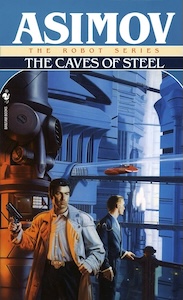
This is a book by Isaac Asimov. I enjoyed the short stories in I, Robot and wanted to read the Robot series, starting with The Caves of Steel.
Plot
Earth people live in enclosed metal cities (caves of steel), the protagonist lives in what used to be New York. A group of Spacers went to Earth to live in a segregated settlement called Spacetown.
Spacers cannot cohabit with Eartheners because they eradicated diseases back on their planet and don't have built immunity. Eartheners can visit Spacetown under strict conditions.
Spacers make use of robots in their society, while Earth people are a lot more reluctant to do so. Lije is a police officer who gets paired with a robot from Spacetown, Daneel, to investigate the assassination of a Spacer.
In the end it turns out it was his boss who assassinated the Spacer. The reason was that the boss was a member of a group called Medievalists, a group particularly opposed to robots in society. He learned that the Spacers wanted to start incorporating robots in Eartheners' society, starting with Daneel. The boss has a plan to destroy Daneel.
However Daneel was actually made in the image of the person assassinated and Lije's boss is short-sighted, so he confused the human for the robot. That's also why Daneel, who can analyze character, didn't feel like the boss was able to commit murder (human).
In the end he was pardoned but agreed to help the Spacers with their end goal of encouraging Eartheners to explore other planets and start a new society there with the help of robots, but as a middle ground between Earth culture and Spacer culture.
Themes
Malthusianism. This book was written in 1953 and Earth had 2.6 billion people back then. Earth’s population in the book is 8 billion people, like today, but in the book they had to live constrained lives (see Communal space) for the world to be sustainable. So on this one Asimov’s prediction was off.
Robots as witnesses. Another prediction Asimov seems to have gotten wrong is that robots are not valid witnesses despite having perfect memory. I believe today CCTVs are used all the time to incriminate people.
But we can argue that if this came from a highly complex robot we’d need to have guarantees that it didn’t tamper with its memory, so the CCTV comparison is not 100% fair.
Communal spaces. In the caves of steel, people use public baths and communal kitchens because the population was too big to support the scale of individuality.
It made me think about why eating out is almost always more expensive than cooking at home. Why is there no restaurant that leverages economies of scale to provide cheap food?
Eugenics. The Spacers screened children based on desired genetic traits. It’s interesting that Spacers didn’t have myopia among them because of that. This reminds me of the movie Gattaca, where the main character who wasn’t genetically screened has myopia and has to constantly hide it.
Diseases. Because colonization happened after humans had developed ways to screen for diseases and no further contact with Earth occurred, the colonies were disease free.
Minority report. The robot Daneel can tell whether someone is capable of committing murder. This reminds me of the movie Minority Report which revolves around the psychics that can tell whether someone will commit a crime but in the end it’s found that they’re flawed.
Machines using machines. At some point the robot Daneel uses a computer to search for some files. I found the imagery amusing and it reminds me of recent developments where AI agents use subagents or MCP servers.
Determinism. It’s pointed out that the robot brain is completely analyzable. It suggests that the robot software is deterministic but I don’t think this will be true in reality. This reminds me of a post I wrote on Complexity and the Robot Psychologist from the I, Robot book.
Overkill Processing. At some point Lije asks Daneel about the time. He then realizes he could have just checked his watch.
This is a current topic analogous to how we ask ChatGPT a question that can easily be answered via Google, or when I ask Claude Code to fix a typo instead of fixing it myself, like I suggested in Coding with AI.
Now I’m at a point where I don’t type code in the editor anymore, and do everything through Claude code or the terminal
Scale is the Mother of Invention. Daneel expresses surprise at the sophistication of Lije’s computer system and explains that Spacers didn’t develop them because they have a much smaller population and don’t need to deal with processing at a larger scale.
This reminds me of how big tech companies often cannot use open source systems due to unique scaling challenges. I think this is less true these days.
Europe vs America. In a way the Eartheners vs Spacers reminds me of Europe vs America. Like Eartheners, Europeans colonized the new world and a new culture was formed. Like Eartheners, Europeans today feel a bit more reluctant to adopt technology than Americans.
The 60mph walkway. This walkway is a series of parallel strips that gradually accelerate until the last one that reaches 60 mph. The 99% invisible podcast covers it in an episode though it didn’t mention Asimov.
The walkways are so effective at moving people that roads are not used anymore, except for emergency vehicles and police cars.
The throat-speaker phone. This is a device that can pick up vibrations from the throat and generate speech from it. It reminds me of Wisprflow, an AI tool I’ve been using occasionally which can recognize speech even when whispering.
Nutritional yeast. Most of the calories consumed by inhabitants of the Caves of Steel is nutritional yeast, suggesting it’s one of the most effective ways to produce food.
I was curious about this and learned about Torula yeast protein.
Conclusion
I didn’t like this book as much as the short stories from I robot. I like the world in which the story happens, with the caves of steel and societal changes but the plot itself is a bit underwhelming.