kuniga.me > Books > Notes From The Underground
Notes From The Underground
Summary
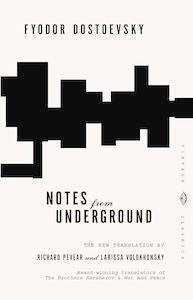
This is a short story by Fyodor Dostoyevsky. It is a first-person narrative by the “underground man”. The book is divided into two parts. In the first, he rambles about different this such as free will. In the secondd he recounts some episodes from his life, such as the his encounter with a unknown officer, his “friends” farewell party and a lecture to a prostitute.
The underground man is a very negative person: anti-social and cynical, but sometimes contradictory and absurd. But perhaps he’s just an exaggerated version of a side that everyone has a bit of.
Officer Encounter
He recounts:
I was standing beside the billiard table, blocking the way unwittingly, and he wanted to pass. He took me by the shoulders and silently – with no warning or explanation – moved me from where I stood to another place, and then passed by as if without noticing.
On this “humiliation” the underground man keeps thinking of vengeange, for years. He comes back to the same place where the officer is a regular and tries to purposefully bump into his but always chickens out and yields the way. He writes a letter asking him to apologize. He dreams that the officer would do so and they would become friends. He never sends the letter.
Farewell Party
The underground man has some acquaitances from school who he despises. He learns one of them, Zerkov, is now an officer and being sent off by his friends with a farewell party. The underground man is not invited but manages to beg one of his closest acquaintances to invite him.
At the party he behaves awkwardly, is largely ignored by his acquaintances, hates being there but cannot leave.
Prostitute
After the party disbands, the underground man meets with a prostitute. He spends time lecturing her, and criticizes her for her life choices. He gives her his address, but later regrets. She later takes up the offer and visits him, and he gets furious at her for coming and seeing him in his usual deplorable state.
Themes
Primitivism. Thinking himself a intellectual and intelligent man, he seems to praise the simpler man:
I envy such a man to the point of extreme bile. He is stupid, I won’t argue with you about that. But perhaps a normal man ought to be stupid (…)
He then compares the man of “hightened consciousness” to a rat. Who overthinks and doesn’t act. He reiterates this point later:
Perhaps I really regard myself as an intelligent man only because throughout my entire life I’ve never been able to start or finish anything.
He also says this person mulls over things and cannot forget.
For forty years on end, it will recall its offense to the last, most shameful details, each time adding even more shameful details of its own.
Suffering. At some point he considers why someone would moans when they have toothache, even when doing so does not help with the pain? He claims that it’s for the pleasure to annoy people and have them feel bad for him.
Relating suffering and primitivism:
Which one is better? Cheap happiness or lofty suffering?
Determinism. He discusses the laws of nature, determinism (2 x 2 = 4) and free will. He claims that men would act against their interest or logic just to prove they’re humans and have free will, and that a completely determined world would be void of life:
After two times two there would, of course, be nothing left - not only to do, but even to learn. The only possible thing to do, then, would be to stop up our five senses and immerse ourselves in contemplation.
Perpetual Desire. When we want the desire itself, not the thing we desire:
Achieving he likes, but having achieved he does not quite like.
Another example:
It would be the worst for us if our capricious demands were fulfilled. Go on, try giving us more independence, unbind the hands of any one of us, broaden our range of activity, relax the supervision, and we will immediately beg to be taken back under tutelage.
This particular example reminds me of The Tempest, in which the slave Caliban hates Prospero but also have a dependency on him.
Contrast. Wants both suffering and pleasure, thinks of doing something but does the opposite. Hates people but yearns for their acceptance.
I passionately longed to show all that “rabble” that I was by no means such a spiritless creature as I seemed to myself.
Rationally Irrational. He knows he is irrational but can’t help acting this way.
I’m forever exaggerating; that’s where I’m lame.
Mimetic Desire
I wanted to re-read this book because it’s often mentioned in Girard’s Deceit, Desire and the Novel. In it, Girard applies his theory of mimetic desire to works of literature. It involves a triangular relationship: the object of desire, the subject who desires and the mediator, who either owns the object or is also interested in it. Girard argues that the subject only desires the object because of the mediator, hence the “mimetism” (copying).
On the encounter with the officer he says:
Dostoevsky’s hero dreams of absorbing and assimilating the mediator’s being. He imagines a perfect synthesis of his mediator strength with his own intelligence.
He claims that this desire comes from despising himself. He then connects the farewell party with the encounter with the prostitute:
He imitates what he thinks was the conduct of Zerkov’s crew toward himself.
Conclusion
I had read this book many years ago, in Portuguese. I didn’t remember most of the story, but recall liking it. I liked reading it this time as well. Despite being very negative, the character has a rich complex personality and the exaggeration lets us see glimpses of our own.
I had trouble capturing the themes, which I have been doing for books I read. Perhaps it’s the fact he rambles and is all over the place, or I lack the ability to synthetize these ideas, or simply these ideas are too complex to summarize.