Malaysia
We went on a trip to Brunei and Malaysia for about three weeks. This post recounts the Malaysia part, where we visited Sabah in Borneo and a few cities along the west coast of Peninsular Malaysia.
Sabah
From Brunei we flew to Sabah in Malaysian Borneo, or East Malaysia. We stopped at Kota Kinabalu first, where we visited a cultural village called Mari Mari. I have low expectations for cultural villages because they’re often staged and I didn’t like the Maleku in Costa Rica (though I did enjoy the San village in Namibia).
For this one, the cultural part was better than in Costa Rica, but it was still okay. I did like the performance at the end of the Magunatip dance, where some performers move bamboo poles on the floor and dancers dodge them while dancing. I had seen this on YouTube or Reels and I hadn’t realized it was from here.
Later we stayed in a lodge that ran river cruises along the Kinabatangan. Borneo has been heavily deforested and even the forest we see today is recent growth, much like in Costa Rica. Unlike Costa Rica, though, there’s still a huge demand for land, mostly for palm oil, so you see it everywhere. Even in protected areas only the area surrounding the river is covered by forest, so it feels like the forest is a facade. There is one upside for us tourists though: animals are concentrated in the forested area so we’re more likely to see them from the river.
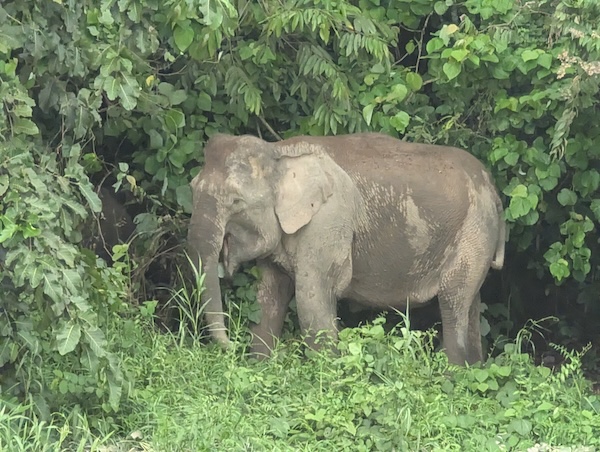
The idea was to look for the big 5 of Borneo (named after the big 5 of Africa): the rhinoceros hornbill, the orangutan, the proboscis monkey, the pygmy elephant and the estuary crocodile. We did four cruises across two days and each took about an hour. Since each trip is basically the same route, it was a bit tedious, but the reason we have to repeat it many times is that seeing one of those animals on a single trip is not guaranteed. We saw all but the orangutan, but we later saw orangutans at the rescue center in Sepilok.
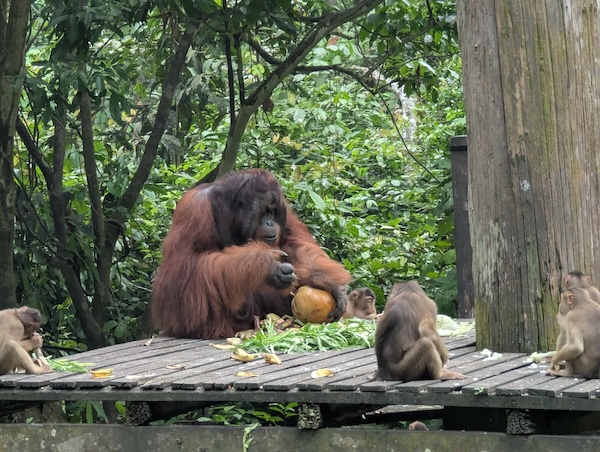
The orangutan center feels a lot like a zoo, except that rescue centers might eventually release the animals back into the wild.
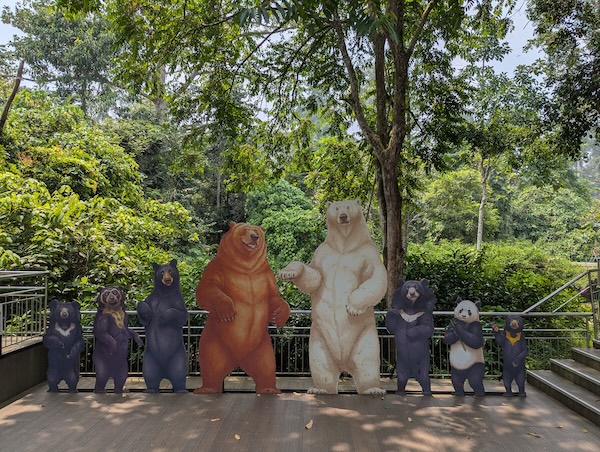
We also saw sun bears in a similar rescue center nearby, with the same idea. I don’t recall if I had heard of sun bears before. The center has very good illustrations. I especially like this one that depicts the different types of bears and their relative sizes.
After Borneo we flew to Kuala Lumpur.
Kuala Lumpur
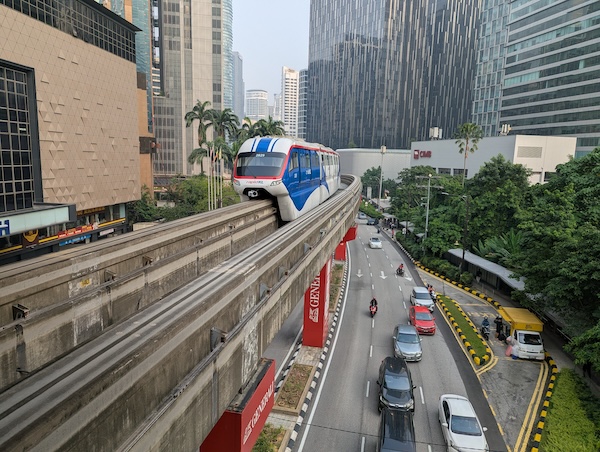
We arrived in Kuala Lumpur in the late afternoon and we took the train from the airport to our hotel. I was happy to learn that KL has subways but they’re not dense enough so at times we had to take Grab because things are just far enough from stations to not be worth walking in the heat.
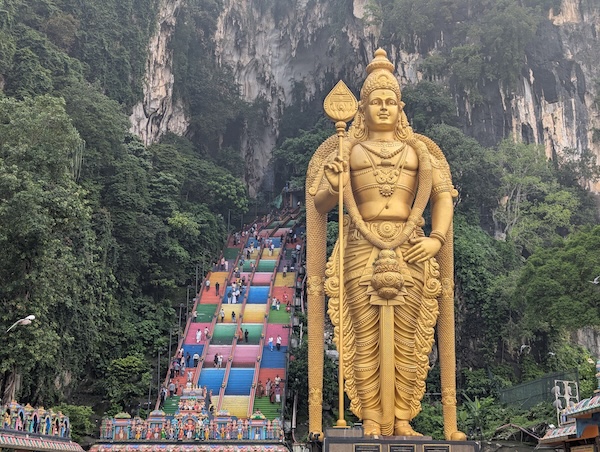
The next day we visited the famous Batu Caves. For some reason I thought it had a Buddhist temple on top but it’s actually a Hindu temple! The cave became a religious site in 1888 after a Tamil businessman noticed the entrance of the cave resembled a vel, the spear carried by the god Murugan. The golden statue of Murugan was built in 2006 and the stair steps were painted in 2018.
We then visited the Bangunan Sultan Abdul Samad. It was originally built by the British in 1897 during colonial rule as a government office but with architecture blending English, Mughal and Moorish styles. It was named after the sultan of Selangor at the time.
In the afternoon we visited the Islamic Arts Museum in Malaysia. It has miniatures of different mosques and Islamic centers around the world. Among the sites depicted, I’ve visited the Nasrid Palaces in Andalucia and the Taj Mahal in India. I later visited the Tranquerah Mosque in Malacca, which was also shown there.
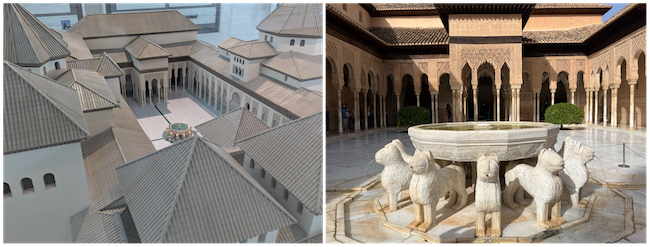
One reason I particularly like miniatures of mosques is that the real ones are often very big, so unless you have a drone or can see them from afar it’s really hard to get a good view of them.
The collection in general is superb and I especially enjoyed the miniature paintings. This museum was opened in 1998, so I was wondering how it amassed such a large collection, especially of Chinese porcelain and Persian and Mughal art. It was built by Malaysian businessman Syed Mokhtar Albukhary and is supported by his foundation. It seems like it might have acquired the works from private collectors.
At night we checked out the Petronas Towers. They were officially opened in 1999 and were the tallest buildings in the world until 2004. They were financed by Petronas, the state-owned oil company. Each tower has 88 floors and incorporates Islamic designs: the floor plan is a shape called Rub el Hizb. Petronas is named after Petroliam Nasional Berhad (National Petroleum Limited in English).
The following day we visited the Muzium Etnologi Dunia Melayu (Malay World Ethnology Museum). It covers Malay culture such as clothing, arts, weapons and customs, but I didn’t find it super interesting. The more interesting museum of the day was the National Museum of Malaysia. It covers the history of Malaysia from prehistoric times to modern times.
At night we visited the Thean Hou Temple. It was built by an association from the Hainanese community to worship the sea goddess Mazu in 1989.
We also visited the Federal Territory Mosque. In Malaysia each state and federal territory has its own official mosque. Kuala Lumpur is one of the three federal territories and its official mosque is the Masjid Wilayah Persekutuan or Federal Territory Mosque.
We did a workshop at Royal Selangor, a company that produces items made of tin and pewter. These are mostly for decoration. Malaysia, particularly Kuala Lumpur, was one of the world’s largest producers of tin. In fact, tin is the major reason Kuala Lumpur exists. Pewter is an alloy composed of tin (97%), antimony and copper. Today the primary use of tin is for solder, another alloy made mostly from tin (97%), silver and copper.
Malacca
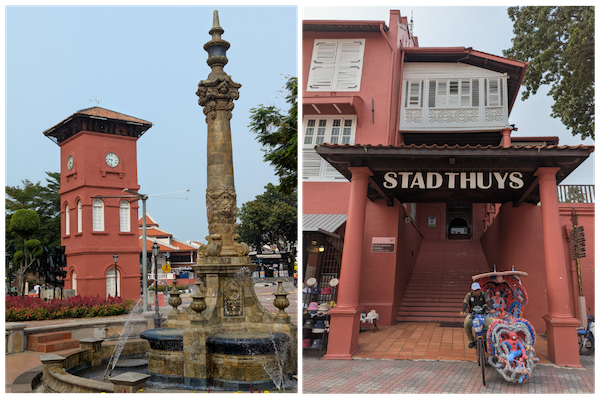
Malacca used to be a major trade center until the Portuguese conquered it and the traders dispersed to other regions. (See history.) When the British took over they didn’t use it as a primary colonial city, so many historical buildings have been preserved, including some Portuguese and Dutch buildings.
Chinese immigrants have been moving to Malacca since the early days of the Sultanate. Many came as single men and married local women. This developed into a distinctive culture called Peranakan Chinese or Baba Nyonya. This community evolved and expanded with subsequent waves of Chinese immigrants, especially from southern China. We visited the Baba & Nyonya Heritage Museum which used to be the residence of a wealthy Peranakan Chinese man called Chan Cheng Siew.
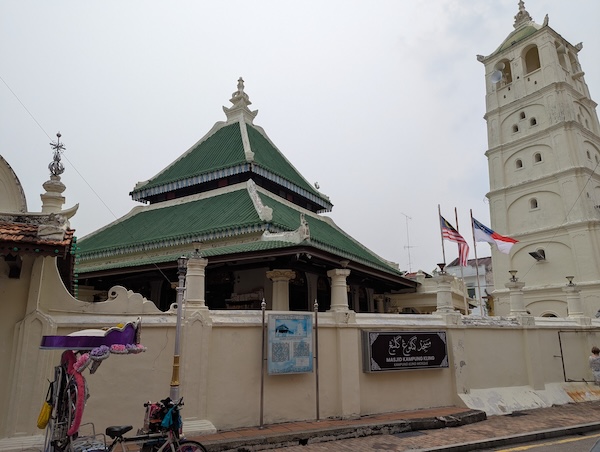
Malacca also has a few mosques with an older architectural style. Although they are simpler than the other ones we visited, I also like them because I feel like they have a more local flavor. I especially liked Kampung Kling Masjid, founded in 1748, during Dutch rule.
We also visited the Portuguese settlement area. The descendants of Europeans who intermarried with locals are called Kristang (from Christians). I was hoping to see more evidence of their culture but wasn’t able to notice anything. The only obvious signs are the restaurants with Portuguese names and a small Christ the Redeemer statue inspired by the one in Rio but it was built rather recently, in 2017. It was pretty underwhelming.
The reason we went to Malacca and to Malaysia in general was to attend the wedding of a friend from Malaysia. He’s Peranakan Chinese so it was really wonderful to participate in the ceremony, mixing Chinese traditions with Christian ones.
In 2019 I was also fortunate to attend a wedding in southern India, in Hyderabad, and it was similarly a very special experience.
Ipoh
We took a train to Ipoh, but since there’s no train station in Malacca proper, we took a Grab to Tampin, which is one hour away.
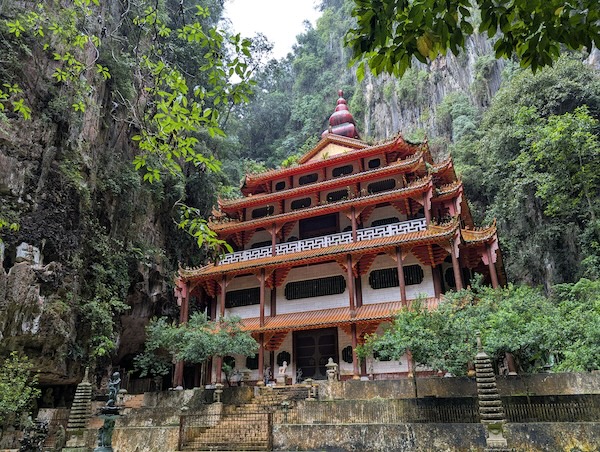
Ipoh is relatively small but it has nice Chinese temples in caves, like the Batu Caves in Kuala Lumpur: the Perak Cave Temple, Kek Lok Tong Cave Temple and Sam Poh Tong Temple. My favorite was the latter, even though we were not initially planning to go there. I like the aesthetics and the fact that it has a huge building in a clearing in the cave.
George Town
George Town was our last stop. We took the train from Ipoh to Butterworth and then a ferry to Penang Island where George Town is located.
We checked out some famous sites near downtown such as Kapitan Keling Mosque, Fort Cornwallis, Straits and Oriental Museum and Cheong Fatt Tze (The Blue Mansion). None of them were particularly interesting to me, perhaps because they were too similar to other places we visited during this trip.
We went further south to Penang Hill. There is a cable car that takes you to the top of the mountain, but we decided to climb the stairs. One of the most interesting parts of this trail is that there are some people who live along the trail and a smart resident put out a fridge with drinks which people can buy by leaving cash in a jar. It’s an honour system (though it has a camera). I bought a bottle of water, but I forgot to take a picture!
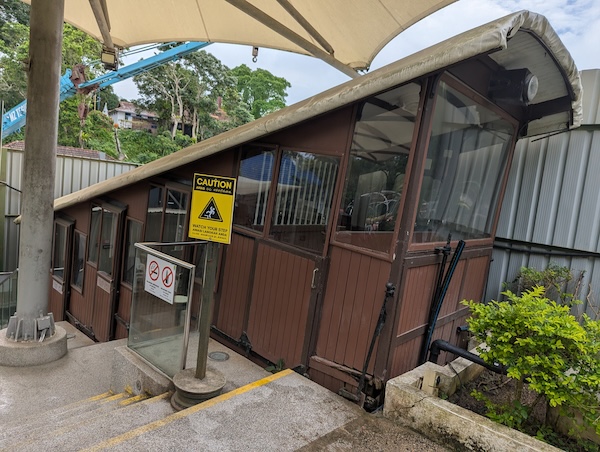
We ended up taking the cable car to go down because we were really tired and it started raining a lot. The one surprise we had is how many people actually fit in those cars.
Another site I really liked around the area is the Kek Lok Si Temple, a huge temple complex. Kek Lok Si (極樂寺) means Temple of Supreme Bliss in Hokkien. It was founded in the 1890s by a Buddhist monk, Beow Lean, from Fujian, China. Among the people who financed it was Cheong Fatt Tze.
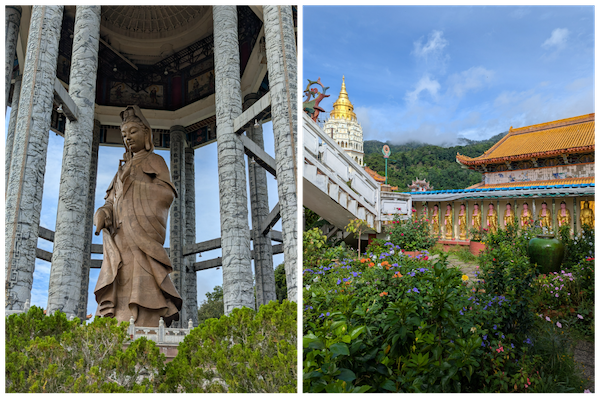
The grandeur of the temple reminds me a lot of Fo Guang Shan (佛光山) in Kaohsiung, Taiwan. It has a giant Buddha and a garden with thousands of Buddha statues.
Two other temples I liked are Dhammikarama Burmese Temple and Wat Chayamangkalaram (Thai) on the west side of George Town. They are very sumptuous with large statues and golden stupas and with styles characteristic of Burma and Thailand, respectively.
Conclusion
It was a fun trip! I now know a lot more about Brunei’s and Malaysia’s history, culture and food! On the surface, Brunei feels culturally similar to Malaysia in terms of food, language and religion, except that the ethnic Chinese and Indian populations are a lot smaller.
I found some old notes listing Borneo as one place I’d like to visit, so I’m glad to have checked that box, even though I had higher expectations for the orangutans. I also knew about the palm oil issues from Professor John Baez but it was another thing to experience this in person. To make things even more tangible, when we were there, there was a huge wildfire on the Indonesian side, so a big part of our trip was hazy, especially in Kuala Lumpur.