kuniga.me > Docs > History of Malaysia
History of Malaysia
Index
- Pre-History
- Early History
- The Sultanate Age
- European Contact
- Japanese Occupation (1941-1945)
- Unions
- Independence (1957 - )
Malaysia as a country did not exist until 1962. This document covers the history of the different locations that are part of the country today.
Pre-History
From 12,000 to 3,000 BC, archeological evidence suggests that peninsular Malaysia was inhabited by the hunter-gatherer Hoabinhian culture which comes from the Hoa Binh in Northern Vietnam.
Around 3,000 BC it’s possible that farmers from Austroasiatic culture settled in the Malay Peninsula. These are the same groups in Thailand, Cambodia and Vietnam.
It’s believed that the Austronesians originated from today’s Taiwan and spread through Southeast Asia, Oceania and eventually Madagascar.
They probably reached Borneo in 2000-1500 BC and later reached the Malaysian peninsula, but the timeline for the latter is less clear because of multiple migrations from different cultures.
Malay, Indonesian and Tagalog all belong to Austronesian languages.
Early History
Indic Influence
Archeological evidence points to contact with Indian civilizations through trade up to the 13th century.
One of the most preserved archeological sites is from the Bujang valley, part of the larger trading center called Kedah.
It contains Hindu temples and sculptures, and also Sanskrit writings, indicating strong Indian cultural influence.
Srivijaya (7th to 13th century)
The Srivijaya was a Malay-speaking, Buddhist kingdom centered in Sumatra Indonesia, that controlled the maritime trade between China and India.
This kingdom spoke old Malay and evidence points to it being the lingua franca for trade with other cities, including in Peninsular Malaysia. They were recorded in writing using the Pallava script from Southern India.
The Sultanate Age
Beginning in the 13th century, rulers across the region started converting to Islam.
Because Malaysia traded with Muslim Arabian and Indian merchants, converting to Islam provided commercial advantages and let them participate in the political network of Sultanates around the world.
Malacca Sultanate (1400-1511)
According to traditional accounts, the Hindu prince Parameswara from Srivijaya fled Sumatra and founded Malacca around 1400.
It’s unclear if Parameswara himself converted to Islam or if it was one of his successors but it’s believed Malacca was already a Sultanate in the 15th century.
It grew in power due to its strategic location in the strait of Malacca and diplomatic relations with China, it flourished as an entrepot.
Its influence helped spread Islam further across its trade network, the same way Srivijaya did with Buddhism.
Malay continued to be the lingua franca but writings changed from Pallava to the jawi script.
Kedah Sultanate (1136-1909)
Kedah’s royal sources point to 1136 as the start of the sultanate but there’s no contemporary evidence to confirm it.
It was in the intersection between the Malay and Siamese worlds.
In 1786 the sultan Abdullah Mukarran Shah allowed the British to occupy the Penang Island, with the expectation that the British would provide protection against Siam and Burma.
The British agreed to pay annual installments to the sultan, which continues to this day, with the Malaysian federal government paying the state of Kedah an annual sum.
In 1821 Siam invaded Kedah on the grounds of disloyalty. In 1842 the sultan was restored but the state was broken up into smaller administrative units including Perlis, Kubang Pasu and Setul.
Perlis in particular became its own Sultanate in 1843 and is a separate state today. Satun is now part of Thailand.
In 1909 the British and Siam signed the Anglo-Siamese treaty in which several Sultanates such as Kedah and Perlis passed to British hands.
Perak Sultanate (1528-1874)
After the Portuguese conquered the Sultanate of Malacca the royal family dispersed to other regions and founded new sultanates. The Perak Sultanate was founded in 1528.
Large amounts of tin were found in the region and it became one of the world’s largest tin producers in the 19th century. Chinese immigrants arrived to work in the mines and as merchants, in particular in the Larut district.
Two major factions (one Hakka and one Cantonese) competed over mining interests, leading to the Larut wars (1861-1874).
This war and the dispute over the sultan’s successor provided reasons for the British to intervene and gain political power over the region. In 1874 the British installed a resident whom the sultan had to consult on most matters.
Selangor Sultanate (1766-1874)
The Selangor Sultanate was founded in 1766 by Raja Lumu. He was a descendant of the Bugis from Sulawesi.
It was based in Kuala Selangor. Like with the Perak Sultanate, tin mines were discovered in the sultan’s domain.
One particularly important mining town was Kuala Lumpur, which like in Perak led to conflicts between factions, then British intervention and the establishment of a resident.
Johor Sultanate (1528-1946)
After the Portuguese conquered the Sultanate of Malacca the royal family dispersed to other regions and founded new sultanates. The Johor Sultanate was founded in 1528. It encompassed what’s the Johor state and the Riau state in Indonesia today.
This sultanate fought frequently with the Aceh Sultanate located in North Sumatra.
In 1641 Johor allied with the Dutch to expel the Portuguese from Malacca.
In 1819 the British established themselves in today’s Singapore taking advantage of a disputed succession of the Sultanate.
In 1824 the Anglo-Dutch treaty was signed which ended up splitting the Sultanate into 2: Johor with a sultan backed by the British and Riau, backed by the Dutch.
Later that year the English formalized their acquisition of Singapore from the Johor sultan.
The Johor Sultanate remained relatively independent from the British compared to other Sultanates but it eventually combined with other Sultanates into the Union of Malaya in 1946.
Sabah
The region corresponding to Sabah today was under the influence of two Sultanates: the Brunei Sultanate and the Sulu Sultanate based in the Sulu archipelago (in today’s Philippines).
In 1881 British entrepreneurs got permission from the Sulu sultans to explore timber in the region. The region expanded and eventually became a British colony.
The Philippines formally asserted a claim over Sabah in 1962 due to the Sulu connection, but Malaysia has been governing it since it joined the Federation in 1963.
Sarawak
The region corresponding to Sarawak today was under the influence of Brunei.
In 1841 the English adventurer James Brooke was granted control over a portion of the region and gradually expanded it to today’s border.
European Contact
One of the most consequential European actions was the Anglo-Dutch treaty of 1824.
The Anglo-Siamese treaty was also important because it defined the modern border of Malaysia and Thailand.
Another lasting legacy is that during the British administration the Latin writing system called Rumi started spreading out through colonial schools, newspapers and official documents.
Portuguese Malacca (1511-1641)
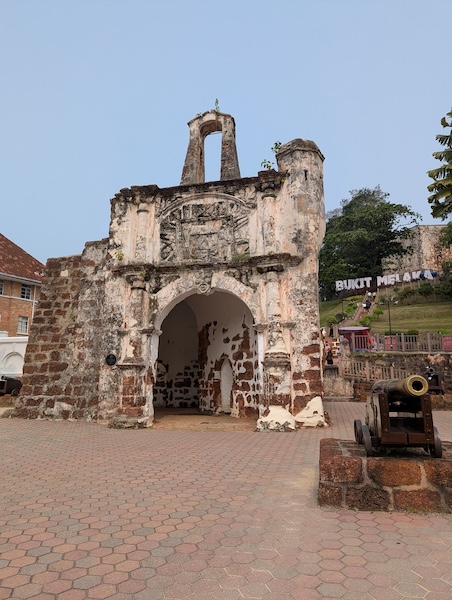
In 1511 the Portuguese conquered Malacca. They wanted to undercut the Muslim merchants through which goods flowed to Europe.
They didn’t succeed in overtaking the trading network because it moved to other ports such as Aceh and Johor (to which the sultan fled).
The Portuguese held the city for 130 years, until the Dutch captured it in 1641 with the help of the Johor sultanate, but the city never recovered its former position. The Aceh sultanate in Indonesia also benefited from this.
Dutch Malacca (1641-1824)
The Dutch, through the VOC, had its main commercial center in Batavia (today’s Jakarta) but having a Portuguese fort in the strait of Malacca posed a problem.
They therefore decided to take over Malacca from the Portuguese but did not use it as a major trading port afterwards.
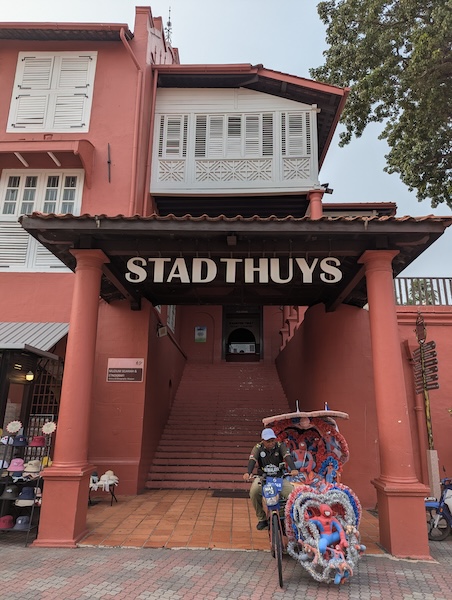
During the Napoleonic wars, the Dutch asked the British to take over its colonies in Asia temporarily to avoid them falling into the hands of the French, when they occupied the Netherlands, in 1795.
The British destroyed all the fortifications in 1807, partly to reduce the defensive powers of the city when the Dutch took control back, which they did in 1818.
In 1824 they signed a treaty with Britain, the Anglo-Dutch treaty of 1824 in which the Netherlands ceded Malacca to the British while Britain ceded Bencoolen in Sumatra to the Dutch.
British Malacca (1854-1957)
The British already controlled Penang and Singapore for trading outposts, so Malacca was never a major financial center, which contributed to the preservation of its historical buildings.
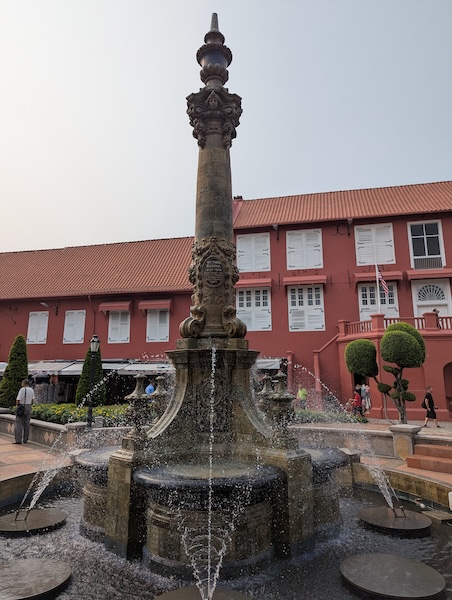
The Chinese community of the city (known as Peranakan Chinese) flourished during this era working as merchants and intermediaries between the locals and the British.
British Perak (1874-1896)
The first resident was James Birch. He planned reforms that would weaken the local chiefs. They rebelled and assassinated Birch in 1875.
The British launched a military campaign in 1875-76 (called the Perak wars) which defeated the resistance and the sultan went into exile in Seychelles.
Ipoh emerged as a tin mining town. The British provided the infrastructure such as railways and administration while the Chinese owned and worked the mines.
In 1896 Perak joined the Federated Malay States.
British Penang (1786-1824)
In 1786 the British had acquired the island of Penang and developed the city of George Town to serve as an entrepot for trading in Asia, much like it did with Singapore.
In 1800 the British expanded the territory by purchasing the province Wellesley now called Seberang Perai.
During the tin boom that benefited the neighboring Perak, George Town served as the port city for exports.
In 1824 Penang formed the Straits Settlements.
British Selangor (1874-1957)
Before the British Klang was the administrative center of Selangor, but in 1880 the British transferred it to Kuala Lumpur.
Klang remained and is to this day the royal seat.
Sabah: The British North Borneo (1881-1946)
In 1881 British entrepreneurs obtained agreements from the sultan of Sulu and founded the British North Borneo company, which exploited timber.
In 1884 Sandakan became the capital. The company encouraged plantations of tobacco and rubber.
During the war Sandakan was destroyed and instead of reconstructing it the British moved the capital to Kota Kinabalu.
The company did not have the means to reconstruct and administer Sabah so it transferred its assets to the British crown in 1946.
Sarawak: The White Rajah (1841-1946)
Brooke helped the Brunei representative stop the rebellion and in return he was granted authority over a region around the Sarawak river.
He became known as the white Rajah. His dynasty expanded the territory of Sarawak at the expense of Brunei including the Limbang district which is why Brunei is geographically separated into two today.
In 1888 Sarawak became a British protectorate. Similar to Sabah, after the Japanese occupation of Borneo ended in 1945, the Brooke family decided to transfer control to Britain so in 1946 it became a crown colony.
Japanese Occupation (1941-1945)
Japanese troops landed in Thailand in December 8th 1941 and started heading south. In December 10 and 11 Japanese aircrafts bombed Penang, and the British withdrew in the 16th. By the 19th the land troops reached Penang. By 11 January 1942 they reached Kuala Lumpur and in 8 February Singapore. The main objective of the Japanese was to capture Singapore since it was Britain’s main naval base in Southeast Asia.
A different front had reached Borneo in December 1941. The Japanese landed in several cities in Sarawah, Brunei and Sabah. Japan’s main interest in Borneo was oil.
Japan’s occupation led to food shortage due to supply chain disruption, especially of rice. Ethnic Chinese were targered because of the war with China.
Many prisoners of war were sent to Sandakan in Sabah. About 2,400 prisoners of war were forced to march from there and all but 6 survived because they fled, which are now known as the Sandakan Death Marches.
Japan surrendered to the Allies in August 1945. After this, Japan started surrendering on its occupied territories. They formally surrendered at Labuan, Borneo on 10 September 1945, and the regional surrender in Singapore followed on 12 September.
Unions
Straits Settlements (1826-1946)
A few years later after the British acquired Malacca, the East India Company established the Straits Settlements which included Malacca, Penang and Singapore.
It would eventually be dissolved and it got merged with other states into the Malayan Union in 1946.
Federation (1896-1946)
The British had residents in multiple Sultanates but they were administered individually. To centralize it, the British created the Federated Malay States in 1896 formed by Perak, Selangor, Negeri Sembilan and Pahang.
The unified role became the resident-general based in Kuala Lumpur.
This Federation did not include Kedah, Kelantan, Terengganu and Perlis because they were still under Siamese suzerainty (this would change in 1904 with the Anglo-Siamese treaty); and also Johor which they had less control over. These were known as the Unfederated states.
The Japanese military invaded Malaysia in 1941-42 and effectively ended the British administration.
Federation of Malaya (1948-1957)
After Britain regained control, it decided to reorganize its dominions and created the Malayan Union in 1946, which included the unfederated states and also the strait settlements.
Malayan leaders protested because sultans would lose a lot of their power. They also wanted more restrictions on citizenship because the British were bringing a lot of Chinese and Indian laborers.
This led to changes and the formation of the Federation of Malaya in 1948.
The Malayan Emergency (1948-1960)
The Malayan Communist Party (MCP) launched an armed insurgency against British colonial rule in 1948. Moderate Malaysian parties sided with Britain.
The communists relied on guerrilla war in the jungle so the British came up with the Briggs plan in 1950 which consisted of relocating hundreds of thousands of villagers (mostly ethnic Chinese) into guarded new villages to cut resources from the guerrilla warriors.
The Malay-British coalition eventually defeated the Communists and the Emergency ended in 1960.
Independence (1957 - )
In 1957, after peaceful negotiations the British agreed to independence. In 1963 Sabah achieved self-government and together with Sarawak and Singapore joined the Federation of Malaysia and it became Malaysia.
In 1965 Singapore separated from Malaysia on mutual agreement (see History of Singapore).
Konfrontasi (1963-1966)
President Sukarno of Indonesia opposed the creation of Malaysia claiming it was a neocolonial project.
Indonesia invaded Sabah and Sarawak and conducted operations in peninsular Malaysia. The British, Australia and New Zealand aided Malaysia. The conflict ended in 1966 after Sukarno’s power weakened.
The Second Communist Insurgency (1968-1989)
The MCP resumed an insurgency campaign this time operating on the Malaysia-Thailand border and backed by China.
The conflict went on for two decades until China’s foreign policy changed and in 1989 the Hat Yai Peace Agreement was signed between the insurgents and Malaysia and Thailand.
Interestingly Malaysia established diplomatic relations with Communist China in 1974. This was a pragmatic economic move despite the ideological differences.