kuniga.me > Docs > Hindu Mythology
Hindu Mythology
Index
Concepts
Cosmos
In Hinduism the cosmos encompass everything, including the metaphysical. It’s roughly corresponding to “universe” but the latter has a more physical connotation.
The cosmos goes through a cycle of creation, transformation and destruction. It’s not a continuous linear timeline as in Western philosophy.
Matrikas
Matrikas or mother goddesses represents a group of powerful female deities. The most common group is Saptamatrikas or the 7 matrikas:
- Brahmani
- Chamunda
- Indrani
- Kaumari
- Maheshvari
- Narasimhi
- Vaishnavi
Shakti
Shakti, or feminine power, is the idea that male gods are paired with female goddesses. Males represent consciousness and principle. Females represent manifestation, and action.
Examples:
- Brahmani (Brahma)
- Maheshvari (Shiva)
- Vaishnavi (Vishnu)
- Kaumari (Skanda)
- Varahi (Varaha)
- Indrani (Indra)
Trimurti
The trimurti are the three major deities in Hinduism: Brahma (creator), Vishnu (preserver) and Shiva (destruction). This triad encompass a cycle of the cosmos (see Cosmos).
Vedas
The Vedas are the found foundational sacred texts of Hinduism. It comes from the Sanskrit word for knowledge.
Gods and goddesses
Brahma
Is the creator god, responsible for creating the universe and living beings. One of the three gods on the Trimurti.
Brahmani
The goddess who represents the Shakti of Brahma. She’s part of the Saptamatrikas (see Matrikas).
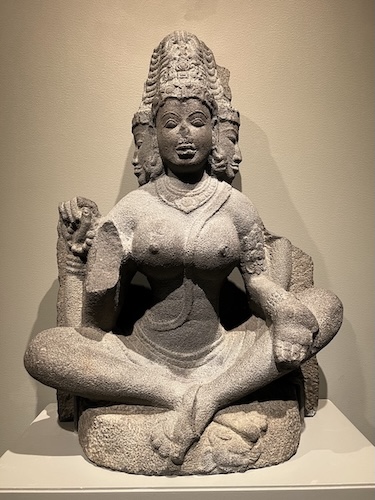
Brahmani is often depicted with four heads (like Brahma, symbolizing the 4 vedas) and carrying a rosary.
Chamunda
Chamunda is the goddess associated with destruction of evil, and with death. She’s often depicted with an emaciated body, skull garlands, carrying weapons of severed heads.
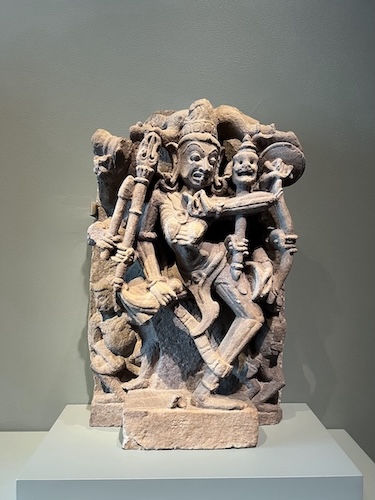
She gets her name from defeating two demons, Chanda and Munda. The story goes that Durga was battling an army of demons in the Devi Mahatmya. Then from her forehead emerged a terrifying goddess who kills the demons Chanda and Munda.
In some traditions Chamunda is one of the forms of Kali, the goddess of time, death and transformation.
Krishna
The god Krishna has many roles: divine child, king, philosopher. In some traditions he’s the incarnation of the god Vishnu.
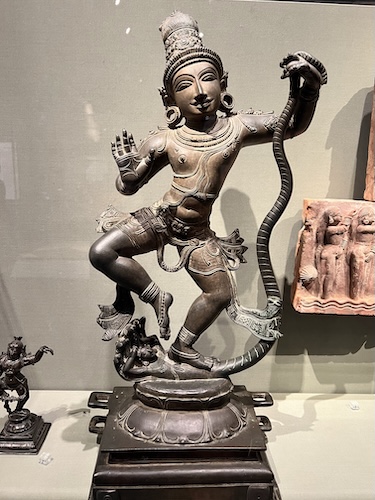
Tale: Kaliya Mardana. The Yamuna river is being poisoned by the many-headed giant snake Kaliya. The young Krishna jumps into the river and on the snake’s heads and dance on top of them. Kaliya is weakened and the poison is neutralized.
Mahadevi
Many other goddesses are considered manifestations of Mahadevi, including:
- Chamunda
- Durga
- Kali
- Lakshmi
- Parvati
- Saraswati
Narasimha
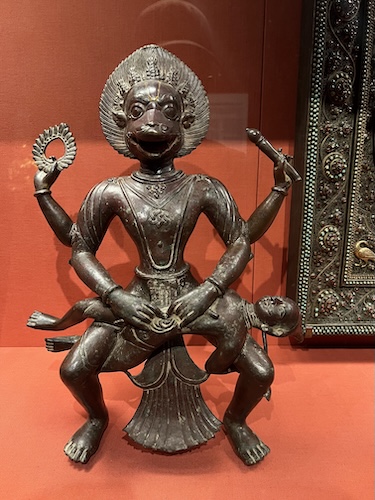
Narasimha is one of the avatars of Vishnu. He’s half man (nara) and half lion (simha).
Tale: Hiranyakashipu. The demon Hiranyakashipu learns he cannot be killed:
- by man or beast
- inside or outside
- day or night
- by weapon
- on earth or in sky
he then assumes he’s immortal, and demands worship. However his son Prahlada is a devotee of Vishnu, and refuses. When attemps to kill Parahlada and asks where Vishnu is, to which Parahlada answers “everywhere”. Enraged, Hiranyakashipu strikes a pillar, from which Narasimha emerges.
Narasimha manages to kill Hiranyakashipu by:
- not being man or best (he’s both)
- on a threshold (neither inside nor outside)
- at twilight (neither day nor night)
- using claws (not weapons)
- on his lap (neither earth nor sky)
Vishnu
Is the god associated with the preservation of cosmic order.