kuniga.me > Books > On Photography
On Photography
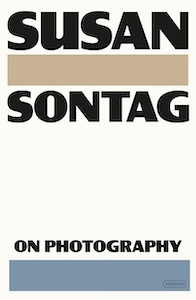
On Photography is a book by Susan Sontag. She covers photography and the act of taking photos from multiple angles: philosophy (metaphysics: reality, time), psychology (what motivates us to take photos, our notion of beauty) and art (is photography a form of art? comparison with painting, especially impressionism).
Themes
Why we photograph
Sontag covers several reasons why people take photos. One is that people like to show off:
It seems positively unnatural to travel for pleasure without taking a camera along. Photographs will offer indisputable evidence that the trip was made, that the program was carried out, that fun was had.
However, this documentation process can become the goal:
Travel becomes a strategy for accumulating photographs.
Implying that the trip and experiences themselves are of second order. One of the more paradoxical and thought-provoking arguments the author makes is that we use photos to preserve reality because we can’t handle it:
In modern society, the discontent with reality expresses itself forcefully and most hauntingly by the longing to reproduce this one.
One way I can interpret this is via a personal example: sometimes I enjoy trips more afterwards! During trips I’m often jet-lagged, exhausted and unable to enjoy the moment. I can remember the moment, including sensory information and enhance it by taking photos, and when looking back at it, I feel an enjoyment that I don’t recall feeling at the time. I don’t know if this happens to other people, though.
Another reason, which she keeps coming back to, is aesthetics.
Beauty is in the eye of the beholder
A recurrent argument Sontag makes is that anything is worth photographing for aesthetic purposes. In fact, photography confers value/beauty to subjects:
An ugly or grotesque subject may be moving because it has been dignified by the attention of the photographer.
People get anxious when they’re photographed because they want to look better than they are. Related to that, the author says that
The traditional function of portrait painting to embellish or idealize the subject remains the aim of everyday and of commercial photography, but it has had a much more limited career in photography considered as an art.
Beauty and FOMO:
It’s common for those who have glimpsed something beautiful to express regret at not having been able to photograph it.
I can relate to this feeling and I think that’s what motivates me to take so many photos!
Metaphysics
An argument that has multiple dimensions is that photography lets us see more than what we can with our naked eye. A photo can capture an instant of time of an event that happens too fast for us to be able to absorb in detail, but in a photo we can. From this the author concludes:
Photography doesn’t expand reality. It expands our perception of reality.
This also ties to the previous topic, on beauty:
What is beautiful became just what the eye can’t see.
The author goes further and seems to claim that photography is larger than reality:
The powers of photography have in effect de-Platonized our understanding of reality.
This is in reference to Plato’s cave, a thought experiment which suggests we don’t know reality, because we experience it through our senses. On similar lines:
The photograph is not, even ostensibly, meant to lead us back to an original experience.
and that when we “experience” reality through photos first we are disappointed when we see it in person:
Photography is the reality; the real object is often experienced as a letdown
Another aspect of this issue is that experiencing something for the first time is unique. When we do it in person, we get the whole sensory package, but if our first experience is via sight only, when we get to experience it in person we’re not getting the whole package, since the sight part has been subtracted.
Photography “ruined” our expectations not only with respect to sight, but also to our notion of time:
Our oppressive sense of the transience of everything is more acute since cameras gave us the means to fix the fleeting moment.
It also transforms our relationship with time, by extending our memory:
Photography makes the passage of time more obvious.
Because we can look at an old photo and realize how much time has passed.
Truth
Photos were initially used as evidence of truth, but the author argues that it’s not always the case: as early as 1855 people found out that you could retouch the negatives.
A fake painting falsifies the history of art; a fake photography falsifies reality.
Another issue is that even without editing, photography shows only a slice of reality: time and space, so it can be used to manipulate the truth:
The camera’s ability to transform reality into something beautiful derives from its relative weakness as a means of conveying truth.
The act of photographing can also change reality, much like the observer effect. She cites an example where tourists paid for Indians in the West to change their ceremonies to make them more photogenic.
Art
Sontag suggests photography is similar to impressionist painting in its goals: the artist’s subjective perception, especially the effects of light and color and that both make ordinary, fleeting aspects of everyday life aesthetically interesting.
Related to the Truth topic:
Photography is an art because it can lie.
Photographers had to constantly prove to others that photography is an art, because the camera makes it too easy to create good-looking photographs.
Photography democratizes art: the line between amateur and professional is harder to draw than in painting.
At some point the author claims they started transcending art by claiming they don’t do art with their photos. To me, the fact they can do these sorts of claims tells us that art is not well defined.
Sontag challenges the idea that photography liberated art by focusing on realism and let painting be abstract. In reality photographs are often abstracted and painters still do realistic paintings.
One interesting point of view is that photography often doesn’t seem like art because it’s a more general medium:
Photography is not, to begin with, an art form at all. Like language, it is a medium in which works of art (among other things) are made. Out of language, one can make scientific discourse, (…), and Balzac’s Paris. Out of photography, one can make passport pictures, (…), and Atget’s Paris.
I think it doesn’t fully answer the question of whether photography is art. If we narrow the question and consider those meant for aesthetics, e.g. Atget’s Paris, are these art?
Conclusion
This book provides an excellent discussion on the philosophy of photography and its relation to art and psychology. I felt like writing down quotes from every other page!
I feel like the book is a bit digressive and the arguments scattered and repeated. I later learned this book is a collection of independent essays on the same topic. That helps explain why they don’t follow a cohesive narrative.