kuniga.me > Books > Range (audiobook)
Range (audiobook)
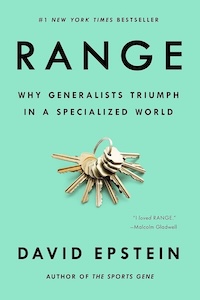
Range: Why Generalists Triumph in a Specialized World is a book written by David Epstein. The full title pretty much summarizes the book: the argument that generalists can have an advantage over specialists or at least complement them.
I listened to the audiobook version of this book twice, and took more notes the second time, so I’ll consider the review for the most recent listen.
Themes
Stories
The book is full of anecdotes from different people.
He talks about a few people who specialized early, for example Tiger Woods. He also mentions László Polgár, who trained his daughters to be chess prodigies, including Judit, who became the best female player in the world at some point. Another example is van Gogh who only started painting at 27.
Most people he talks about are generalists or at least late specializers. He then contrasts Tiger Woods with Roger Federer: one focused on golf since childhood, the other played a variety of sports before focusing on tennis much later.
The author describes these people with a very specific template: he starts telling the story of an anonymous person adding ever more details until at the end revealing who that person is. It feels a bit formulaic but I think it’s very engaging.
Nice vs. Wicked Domains
The author distinguishes between nice vs. wicked domains, chess in particular being a nice domain because the rules are well defined, there’s a clear feedback loop so practice translates directly to performance.
On the other hand some domains are wicked, where problems are vague and open-ended.
I think the overall point is that outside of sports, much white-collar and creative work is more like wicked domains.
Abstraction
He talks about a study on villagers in Central Asia who failed to answer questions like:
In the far north, where there is snow, all bears are white. Novaya Zemlya is in the far north and always has snow. What color are the bears there?
They say they don’t know because they have never been there. The point he makes is that thinking in abstractions can be learned.
The ability to abstract away from a particular situation is itself a learned cognitive skill. This connects to the Range principle because to see patterns, you need to be exposed to a variety of examples.
Delayed Gratification
A common theme of generalists is that because they don’t have any specialty, it might feel like they struggle or have to spend time onboarding in a new domain, compared to a specialist who has been in the domain for a longer time, but the author argues it pays off in the long run.
He makes an association with effortful learning such as spaced repetition and interleaved testing (desirable difficulties).
The book also claims that scientific papers that cite broadly tend to have lower short-term impact but higher long-term impact.
Analogy
The book suggests that reminding people to think about analogous instances improves their problem-solving capabilities.
He goes through an interesting exercise: poses a problem in medicine which doesn’t have an obvious solution. Then he describes an event of a military attack of sorts which makes it more clear how to solve the original problem despite being apparently unrelated.
The company Eli Lilly introduced the InnoCentive program which publicized internal problems in the hopes people from other fields could propose innovative solutions.
Forecasting
He argues that experts are bad at forecasting because they can create a narrow model that interprets events through these lenses and is very compelling but that doesn’t have predictive power.
Another reason is that specialists think they accounted for details and use a narrow margin of error.
A related concept is the Einstellung effect, a cognitive bias in which a familiar solution prevents one from seeing a better, simpler solution. To me this sounds like the saying:
When all you have is a hammer, everything looks like a nail.
Grit
He cites Angela Duckworth’s concept of grit and how it can be detrimental to assume people who change their path do not have grit.
It’s hard to tell when we’re giving up because we don’t have grit or because we realize it’s not a good fit. The latter can come off as an excuse.
One interesting framing is to have grit about long-term goals but have range on the approach. Grit strategically, range tactically.
Reuse of Ideas
The book talks about Gunpei Yokoi, a Nintendo employee who invented the Game Boy. He used to apply previous technologies in new domains, especially for toys in a design philosophy called “lateral thinking with withered technology”.
His designs were often “low tech” gadgets, which had reduced costs and were more reliable than competitors.
Nintendo also reminds me of the Innovator’s dilemma in which cheap technology for specific domains ends up dominating the larger field.
Explore vs. Exploit
The theme of the book fits into this broader struggle between exploring vs. exploiting, breadth-first search vs. depth-first search, early vs. late specialization. I first heard of this terminology in the book Algorithms to Live By.
Conclusion
This book was of interest to me because I think I’m a generalist but have expertise aspirations.
I’m wondering with the advent of LLMs, whether specialists or generalists will benefit more. Maybe I’ll write my opinion on this soon.