kuniga.me > Books > Building a Second Brain
Building a Second Brain
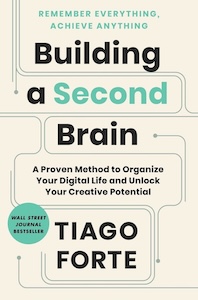
Building a Second Brain is a book by Tiago Forte. He introduces a system for note taking called CODE which stands for:
- Capture
- Organize
- Distill
- Express
Capture
The general guidance for capturing is to not capture everything you run into. The idea is to capture what resonates (that sounds similar to Marie Kondo’s does it spark joy? philosophy for keeping things).
One idea is to have a set of topics you’re interested in and only capture those. Another approach for deciding what to capture is to not take notes of things you already know or agree with. A question to ask: does it surprise you?
He makes another point I found interesting: capturing is about taking notes on the experiences you are already having. It’s about squeezing more juice out of the fruit of life. Savoring every moment to the fullest by paying close attention to the details. I follow this somewhat, but I’m always torn between living in the moment vs. capturing things to relive later (e.g. taking photos or videos during trips).
Organize
For organizing, he suggests a folder system called PARA:
- Projects
- Area
- Resources
- Archive
The projects directory contains sub-folders related to the projects you’re working on. They’re short term and specific. The area folder is more long term or recurrent and broad (e.g. finances, paying rent, eat healthy). The resources are for things you’re not working on, but find interesting, including quotes or topics of research. Finally, archives are for completed projects or abandoned ideas.
One key aspect of organizing is that it’s a means to an end. Don’t capture things or spend time organizing just because. The concept he uses is organize: save for actionability. You should have a goal in mind on what to do with notes. Perhaps resources is the catch-all directory to avoid FOMO, but more effort should be spent on projects and area.
Distill
This step consists in, within the note itself, having different passes of summaries, each pass summarizing the contents further so that only the core idea remains. The idea is so you can quickly recall what the note is about at a glance. This is important for the next step.
One framing of this step I liked is that it exercises your prioritization skills.
Express
This is about taking action on the notes. He provides a few examples such as using them to create (blog post, book, music) or to find connections.
Conclusion
The book is 250 pages but the core idea could probably be developed in less than 50. I found it a bit ironic that there’s a section about distilling but the book itself hasn’t gone through this process (maybe it’s on purpose, to force the reader to practice summarization ;-)).
I was also surprised that I had started following some of the suggested practices before reading the book, for example organizing my notes by topics I want to write about (organize for action!).
Upon reflection, I don’t think it’s a coincidence. At work, someone built an LLM-based system and they kept mentioning second brain and PARA. In fact I wanted to read the book to learn more about it.
I ended up building my own system that borrows aspects from this system. It’s basically a bunch of markdown files organized by project which serves as memory for my LLM agent. I typically don’t read or write to it myself, but I adopted this project-oriented organization for my Google docs.
One day I’ll share more details of my own note taking system and my philosophy on taking notes.
Book Connections
One of the core principles of Forte’s note taking system is the same as Atomic Habits: make it easy to stick with it. Reduce process cost and tie it to some motivation.
In the The Almanack by Naval Ravikant he also touches on prioritization: “If you can’t decide, the answer is no”. Which resonates with this book because a lot of the decision making about what to keep is based on gut feeling (capture what resonates).
There’s a more nuanced connection with a point Naval makes: “Inspiration is perishable. When you have inspiration, act on it right then and there”. Part of the project-oriented note taking system is that you can defer working on it until you have enough material or when you are excited about it, at which point most of the prep work is done.