kuniga.me > Books > Monkeys are Made of Chocolate
Monkeys are Made of Chocolate
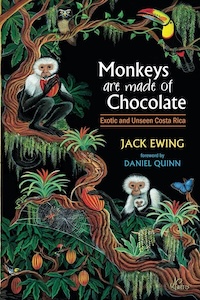
Monkeys are made of Chocolate is a book by Jack Ewing. I bought this book to read during my trip to Costa Rica.
Ewing is an American who moved to Costa Rica to be a cattle rancher / farmer in a plot of land called Hacienda Barú. He later changed his mind and decided to dedicate his life to preserving the environment and investing in ecotourism. The book is a collection of 32 short essays he published in a local newspaper.
Each chapter typically focuses on one subject, usually a specific animal. Since many of those are native to Costa Rica, I actually found it a good companion to my recent trip there and I learned more about some of the wildlife I spotted during hikes.
The title of the book comes from the first chapter: he talks about his cacao plantation which was abandoned after the chocolate market crashed. Monkeys then took over the area and were eating the cacao fruits.
The point he makes is about the economics of the animal world: monkeys can only thrive if they can obtain calories while spending less than that amount in doing so. Once the cacao plantation was abandoned, there was plenty of energy source for the monkeys, so their population soared.
Humans on the other hand cheat by using fossil fuels (and other sources of energy), so they spend little of their energy to obtain calories. Monkeys are made of chocolate, humans are made of fossil fuel.
Themes
Wildlife Corridor
Because each chapter was an essay written independently, some points are made in multiple of them, in particular about wildlife corridors connecting preserved areas. It’s an interesting idea!
Morality
A few chapters touch on the morality of animals. Some species seem cruel because they are parasites, kill the young, bully, etc. but that’s the law of nature, and we should not anthropomorphize or intervene.
When we kill predators that threaten us we cause their prey population to grow unchecked which can have catastrophic environmental consequences.
One example I learned is that if a baby sloth falls off the tree, the mother doesn’t try to rescue it, possibly because it indicates some weakness in the offspring.
Natural Selection
The example cited above is also part of a recurrent theme: natural selection. For the sloth case, the argument goes that baby sloths that had to be supported led to weaker individuals that were eventually selected out of the gene pool.
He never says this explicitly but in places the author seems to suggest we should let nature run its course on humans too:
Our attitude of superiority and lack of respect for her (Mother Nature) has only made us more vulnerable to her whims. (…). If we believe the illusion that we can dominate every other species on earth and bypass the natural selection process (…).
He cites societies where the elderly are left behind or sit in the more dangerous places in a canoe.
Interesting Learnings
- Rainforest trees tend to grow fast, that’s why Costa Rica looks so green even though much of it is reforested and that started less than 100 years ago.
- Rainforest has a diverse ecosystem which makes it more resilient to invasive species.
- Sloths almost always climb down the tree to pee and poop instead of doing it high up in the tree. No one seems to know why.
- Chocolate likely comes from the Nahuatl (Aztec) term xocolatl (bitter water) and cacao/cocoa from cacahuatl (Aztec name for the bean and tree).
- The jabilo or sandbox tree is covered in spikes, its sap can cause blindness and its seed pod explodes!
Conclusion
Overall an easy to read book, providing a mix of memoir with biology. I learned some interesting facts and it was a good companion to my trip to Costa Rica.
Book Connections
In An Arid Eden the author is also a conservationist. His trajectory wasn’t a 180º like Ewing’s farmer to conservationist, but Owen-Smith also didn’t start knowing he would end up being one, altough his life choices always veered towards this direction.
There’s an interesting connection with Project Hail Mary around predator keeping prey population in check, in particular the Taumoeba (predator) and the Astrophage (prey).