kuniga.me > Books > The Naked Sun
The Naked Sun
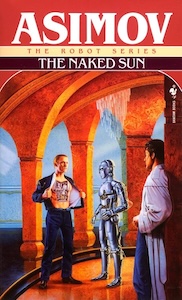
This is a book by Isaac Asimov. I enjoyed the short stories in I, Robot and wanted to read the Robot series, I stared with The Caves of Steel and followed with The Naked Sun.
Plot
Solaria is a very sparsely populated planet and people don't see each other in person, except for their spouses. People make heavy use of robots there and the ratio of robots over humans is pretty high. The wife of the murdered man, Gladia, is the main suspect but no evidence is found, so Lije decides to investigate further. Because of the first law of robotics (robots can't harm humans), it's assumed that robots cannot have committed the muder.
In the end, the crime plot was the following: the roboticist, Leebig, who was the partner of the murdered man found a loophole for the first law of robotics: he deployed some robots with detacheable arms to Gladia's house. In a fist of rage, Gladia removed the arm from the robot and hit her husband with the arm and put it back on the robot.
Leebig had bigger plans to destroy other spacer planets because they threatened Solarian's way of life (sparsely inhatibted) so he got arrested at the end. Gladia, despite being the actual murderer was let go and moved to another spacer planet, Aurora (from where the robot Daneel is).
Themes
Agoraphobia. Solaria is not like Earth with its caves of steel enclosures. Having lived indorrs all his life, Lijie struggles with being outside. On Earth apartments on top the floor are cheaper since ot feels more exposed than those at the bottom.
Viewing vs. seeing. One interesting aspect of Solaria culture is that people don’t meet in person but do all virtually. However the video is high fidelity and has 3D qualities. There’s a distinction between the verbs to view (virtual) and to see (in person). The social norms are very different. As mentioned before seeing is deeply personal and only few people do it. On the other hand, viewing is very casual. At some point Gladia strips naked in front of Lijie without any concerns. When asked about it she says there’s no issue with that because the projected image is not her, which is a thought provoking argument.
Lijie travelled to Solaria which is light years away from Earth only to “VC” with folks. I found it amusing how this reflects some of the work interactions these days. Sometimes we go to the office only to realize everyone is remote and having to VC all day.
Eroded Social Skills. A recurrent theme of the book is the atrophy of social skills due to the isolation. This is the crux of the crime from both Gladia and Leebig points of view. Gladia’s rage was a reaction to a distant husband and lack of human connection. Leebig is an anti-social and the culture of the planet exacerbated his tendencies.
State Control. One of the most interesting aspects of Solarian culture is the Farm. After birth, all babies are sent to this place where they’re raised until adulthood. The goal of this upbringing is to prepare children for a life of isolation and train them to curb their social instincts. This farm is mostly run by robots with one person overseeing the operation, which used to be the murdered person. Children do not know who their parents are.
Besides the eugenics typical of other spacers, birth rates in Solaria are also controlled to keep the population size stable.
Unlike the typical dystopia, there’s no central state enforcing these things but there seems to be a communal consensus among the inhabitants of the planet on maintaining this culture, which is self-perpetuated by strict control of their upbringing.
Conclusion
I like this book much more than Caves of Steel. The plot is clever, but I really liked the social thought experiment of Solaria, and how relevant it seems for modern times, especially during the Covid pandemic.